Ideas for Honoring the Day:
PLEASE
NOTE: in 2020-2021 due to concerns over the coronavirus, March 25th Annunciation
Feast - Day of the Unborn Child events listed on this website or at linked
sites (and many public events including religious services) may be cancelled or
attendance-limited. However, a variety
of at-home alternate "virtual" observances are listed on the home
page as well as this current page and alternate activities section of the events page, and for socially distanced
in-person events see the suggestions below for 2021.
IDEAS
FOR 2021: With the challenge of social distancing still
required or recommended, one suggestion that may work for honoring the day is
to have an extended-period prayer vigil in church -- whether it be
twenty-four hours, twelve, six, or just three (with opening/closing prayers,
and perhaps some formally led prayer in between) this allows people to come
and go throughout the prayer vigil period for various parts of the program avoiding
crowding at any one time. It is
best to choose a time period that includes both daytime hours (when older
drivers feel comfortable coming and going) and at least one evening hour for
those who work until 5 pm. In addition
to putting a notice in the bulletin, posting fliers, and having
the pastor include it in the announcements after services, please make
an effort to have a noticed published on a website -- not just a .pdf
(these must be downloaded and are hard to search) but also on a standard
webpage that can be viewed in a Web browser, for this will make it much easier
for people using a search engine to find your event. In the web version of the notice remember to put the year and keywords
for Feast of the Annunciation and Day of the Unborn Child and also mention the
nearby towns and cities in order to attract people in other localities. For example, if the location of your event
is Lockport, NY -- an ad might say:
Looking for an Annunciation/Day of the Unborn Child event in the Buffalo
- Niagara Falls area? ~ Join Us at…"
Another helpful way to add these search-friendly keywords is to include
brief driving directions to church/venue from various nearby cities and towns. Examples: Full Day Program (24 Hours): A 24-Hour Pro-Life Prayer
Vigil may attract young people, but have the opening and closing at an hour
when everyone can attend, 6 pm for example on March 24th and 25th. (A variation
for Catholic and other churches that begin celebrating a holy day the evening
before can have an opening Annunciation vigil mass and a closing Day of the
Unborn Child the next day on March 25th, with hours for quiet prayer in between
-- this may be more or less than 24 hours if using usual times for vigil and
daily masses.) Short Program
(3-Hours suggested minimum bridging afternoon & evening to include day and
after-work hours): A Catholic church might start with the Mercy Chaplet at
the traditional 3 pm hour, 4:30 Rosary, 6 pm closing pro-life prayers. Mid-Length program: (6 to 12 hours):
A church with daily morning services at 8 am might go from 8 am to 8 pm for a 12
hour program to cover most of the day.
If there is more than one daily mass, the program could link these
together with formally led and silent prayer and/or adoration in between, with
the later designated a Day of the Unborn Child offered for protection of human
life. Or a six-hour
option might begin with the brief but apropos Angelus prayer at the traditional
time of 12 pm (or just before a noon Mass as it takes only 2 minutes prayed
aloud), perhaps adding Exposition/Adoration beginning after Mass, Chaplet at
3:00, Rosary (Joyful mysteries beginning with Annunciation) at 5:30, and
Benediction at 6:00 or a later hour.

There are many ways to make the day memorable and meaningful -- as
the more traditional Annunciation feast or the more contemporary Day of the
Unborn Child. Whether our activities
take place on March 25th or as near as practicable, we can always point out the
gestational interval leading up to Christmas.
On the Annunciation feast, we can focus on Christ’s joyfully announced
Incarnation or the application of its pro-life import--or better still we can
combine the two. But note that as a
pro-life observance, the Day of the Unborn Child is different from other
pro-life memorials in that it is rooted deep in history upon the wondrous and
joyous event of the Incarnation, and this fact that it is founded on the feast
that comes nine months before Christmas should serve to remind us that the
Annunciation honors the Word made flesh--Christ’s conception, for the moment of
Incarnation is truly a celebration of the profound mystery of life as the
unborn Christ in his full divinity highlights the full humanity of all unborn
children. While noting that feast days
that occur during Lent are traditionally more subdued, the Annunciation is
still a day of celebration. For
Catholics its important rank as a "solemnity" does not mean somber or
solemn but derives from the word "sollennis" meaning annual --
occurring every year. In liturgical
language "solemn" also means special, and so a solemn mass for the
Annunciation will be more elaborate (longer, additional parts and prayers) than
usual. Words like festive and
festivities are rooted in "feast" day celebrations, and when the
Feast of the Annunciation is observed on a Friday in Lent, Catholics are NOT obligated to abstain from
food or meat, because solemnities are days for feasting and not fasting. (See the CatholicAllYear page Solemnities Are Not
For Being Solemn for more). The Orthodox lessen their Lenten fast for the day so that fish is
permitted -- the Annunciation being one of only two days they relax the rule
against fish during Lent (the other is Palm Sunday). Below you will find a great range of ideas for keeping the day
special and keeping its meaning in our minds and hearts. There is something for almost everyone. Choose one, and establish it as a yearly
tradition, or try something new each year.
General:
(All ages--public/private, groups/individuals)
 Carnations for the
Incarnation (suggestions
on using this symbol to celebrate the
day)
Carnations for the
Incarnation (suggestions
on using this symbol to celebrate the
day)
Spiritual Adoption~9Months4Life: (prayer for an unborn
child from Mar. 25 to Dec. 25)
Easter Greetings
Noting the Annunciation/Good Friday Link
Highlighting
the Annunciation/Christmas/New Year Connection in Dec. & Jan.
Start a 25th-of-the-Month-Club (monthly pro-life prayer
& special Mar./Dec. activities)
Ideas for Years in which the Feast is Moved (link the two days &
utilize the interval)
Private Observance:
Public Observance: (Also check our Past Events Archive
for ideas from previous years)
Clergy/Church/School
(including the +9 and FirstDays Celebrate Conception campaigns)
Pro-life
Groups/Pregnancy Centers
See Also:
Events--Current
(attend a March 25th event in your area)
Worship
Resources (for church and prayer centered
celebrations)
An Ecumenical Celebration (traditions,
ideas for sermons--various denominations)
American Life
League's Annunciation Web Page (including
suggestions for home, school, and church based activities)

General (All ages--groups and individuals)
Spiritual Adoption (9 months of prayer for an
unborn child--for monthly Spiritual Adoption intentions see the "9
Months 4 Life" page or to receive prayer reminders every 25th of the
month click here to follow
March25info on Twitter, or here for Facebook:
Spiritual Adoption Basics:
Spiritual Adoption is a
particularly poignant way to honor the feast of Christ’s conception. Basically it consists of a symbolically
gestational nine months of prayer for an unborn child in danger of
abortion. We can participate as
individuals and families, or more formally in prayer groups and congregations. A church-based program often begins with
participants filling out prayer-pledge slips
and culminates in a Christmastime parish "baby
shower" offering light refreshments and collecting monetary donations
and needs-list items for a local pro-life pregnancy center--an approach that
beautifully incorporates both the spiritual and corporal works of mercy. Beginning Spiritual Adoption on the
Annunciation and ending in a Christmas-season baby shower has the added
benefits of reinforcing the pro-life aspect of the feast and its theological
significance as the commemoration of Christ's conception, as well as
highlighting the oft-unrecognized pregnancy-length interval between these two
feasts. Both aspects can be opportunely
reinforced during the holidays, particularly at the closing gift shower, to
which the whole parish is invited.
Another advantage of Spiritual Adoption is that unlike one-day
Annunciation celebrations, those who missed the feast day opening of the
program can still join in this symbolic period of prayer--for example, if they
begin in the first three months of the program they can start by praying for
the safety of a child in the first trimester, and change their specific prayer
intention for that child every 25th of the month until Christmas.
Popular Approaches to Spiritual Adoption:
When
done for the feast of the Annunciation, the start date is on or near March 25th
(or the day to which the feast is moved)--to maximize participation it is often
begun on the Sunday nearest or before the date. Pledge slips can be left in pews, in baskets with pencils near
entrances, or included in the bulletin.
The concept of "Spiritual Adoption" and the nine months to
Christmas can be explained in the sermon/homily with an invitation to the
congregation to fill out pledge slips and drop them in the collection or a box
at the back of the church. The slips
can list frequency options--for example:
the Lord’s Prayer daily, prayer meeting weekly, or attending an
additional church service each month.
Participants can choose to pray for a boy, girl, special-needs child,
etc.--or leave the selection up to God.
A brief pro-life prayer can be used or written for the occasion.
A good overview of 9-month Spiritual Adoption
for the unborn including programs from the Annunciation to Christmas can be
found in the 2002 article here by Clare Conneely entitled "Spiritual
Adoption: Nine Months of Prayer" which not only gives practical
suggestions like monthly church bulletin inserts with prayer reminders, but
also links the pro-life movement and spiritual adoption to the growing awareness
of the import of Christ's prenatal life as part of his "hidden life,"
particularly through the story of Marta Catalano who wrote a "Litany to
Jesus in the Womb of Mary" (later given to Msgr. Philip Reilly who
included it in a booklet for the Helpers of God's Precious Infants). The article begins: "The phrase 'the
hidden life of Jesus' often refers to his life at Mary and Joseph's house in
Nazareth. But to Marta Catalano, of Queens, N.Y., it also means his even more
hidden life: in Mary's womb."
Roman
Catholic churches often use Archbishop Fulton J.
Sheen's original spiritual adoption prayer. Click here for a website that includes tips for
Annunciation-timed spiritual adoption (such as having religious ed. students
spiritually adopt unborn babies and begin praying on the day) and links to
resources (for example, Archbishop Sheen's prayer in card and bookmark
form). Many pro-life organizations
recommend the program and there are various resources on the web, for example,
a Spiritual
Adoption Poster and free
print materials at spiritualadoption.org including a selection of Spiritual
Adoption Prayer Cards (for which a donation is appreciated but not
required). Several Catholic
archdioceses that have launched spiritual adoption offer web articles on the
program with suggestions, including this one (click link and scroll down page to Spiritual
Adoption) from the Archdiocese of St. Louis, which includes the Annunciation
start date and baby shower or "birthday party" closing. Particularly helpful is the Spiritual Adoption webpage of The Catholic Diocese of Arlington
Virginia which has offered downloadable files including printable pledge card
slips featuring Archbishop Sheen’s prayer--or, for slips specific to the Feast
of the Annunciation start date see our
downloadable slips below. The Annunciation Church/School Program launched
in the Catholic Diocese of Peoria in 2006 focuses on Spiritual Adoption and has
been requested and successfully implemented in churches and schools of various
denominations throughout the country.
See the Teens section for ideas on
using social networking sites/apps like Facebook and Twitter for Spiritual
Adoption from March 25 to December 25 -- you can also follow us on Twitter and
Facebook for Spiritual Adoption (see homepage
for direct links). Also visit the 2006
section of the Past
Events Archive to read the text used to promote the program in Chicago that
year at St. Hyacinth Basilica.
Ideal
for social networking are the videos Lumen TV/Entertainment has done for
Annunciation to Christmas spiritual adoption available here -- for more on their
program see the Lumen article here.
One
popular Catholic approach of selecting the Annunciation feast date to start a "novena"
of monthly pro-life Masses (often followed by praying the Joyful
Mysteries of the Rosary) can easily be combined with and complement a
Spiritual Adoption program--both reinforce the nine-month interval before
Christmas, and each Mass can be offered for a specific monthly intention
concerning the physical, spiritual, and familial welfare of the
"adopted" children such as those suggested below for church
bulletins. If the novena is for an
entire diocese, a church named for the Annunciation or Incarnation can be
chosen if conveniently located.
Bulletin Reminders/Inserts:
Church bulletins can
announce the program in advance, explain the reason for starting on the
Annunciation, and include monthly reminders with a Spiritual Adoption prayer
plus an additional optional intention for each of the nine months.
(Sample
bulletin text): Please join in our
Spiritual Adoption program and pledge to pray regularly for the safety of an
abortion-threatened unborn child during the nine months from the Annunciation
feast to Christmas. Pledge slips will
be available on _______ at _______. We
begin on the Incarnational feast of the Annunciation because it commemorates
Christ's conception and is increasingly honored as "The Day of the Unborn
Child." At the end of the
gestational nine-month period, a closing Christmastime "baby shower"
will be held collecting donations for a local pro-life pregnancy center. Spiritual Adoption intention for month one:
____________.
(Examples of nine specific monthly intentions added to the
general intention): (1) healthy development for
the child, (2) an uncomplicated pregnancy and delivery for the mother, (3) a
pro-life physician to care for them both, (4) that the father encourage and
facilitate this life-affirming choice, and be willing to act as a responsible
provider, (5) for both parents’ emotional welfare and maturation toward making
good decisions for their child, (6) that they be guided by the Holy Spirit in
considering adoption, (7) for wise counsel from clergy, and encouragement from
friends, relatives, and especially grandparents who will recognize the child as
a new member of the family, (8) that the child once born will continue to be
safe from harm and raised in a moral faith-filled environment, (9) for the
eternal salvation of the child and family.
In addition, the Annunciation Society offers meditations on Christ’s development in the womb as monthly bulletin inserts to be used from the Annunciation to Christmas -- right click to save the MS Word file for "The Nine Months of Jesus in the Womb--Mar.25 to Dec.25.
The Christmas Baby Shower:
Essentially
this is a baby-themed parish get-together with refreshments in which there will
be a donation bin to collect new items and a slotted box for monetary donations
to benefit a local pro-life pregnancy center.
All are invited, but if desired, special “Thank You” invitations can be
sent to those who filled out pledge slips.
The oft-overlooked "Twelve Days of Christmas" after the
holiday rush is a perfect time in which to have the shower reminding us that
traditionally the season really begins rather than ends with December
25th. Epiphany at the end of the twelve
days is also a good choice since the baby gifts can remind us of the gifts
Christ received from the Magi--the popular Annunciation Church/School Program
has the closing party on Epiphany to collect “baby presents for Jesus.” Whether held before or after December 25th,
the shower should be announced well in advance and indicate what items are
needed and how checks should be made out.
The pro-life pregnancy center should be contacted early on for their
needs-list for new items and whether or not gently used baby clothing is also
accepted--this info should also be prominently posted in the church and/or
bulletin in the weeks before the shower.
At the shower, signs, banners, and/or an info table should remind
parishioners that the Spiritual Adoption program began nine months earlier on
the Annunciation Feast of Christ’s conception to reinforce the relationship
between the feasts--this is especially important for those who will come to
donate for the shower but did not participate in Spiritual Adoption--see the
banners (including a "9 Months 4 Life" Spiritual Adoption design)
that can be printed as small signs at our web
banner page. Hint: Pastel blue and pink frosted cut-out cookies
are attractive additions to the refreshments table. Try using these two pastel colors on Christmas shaped cookies to
combine the shower and holiday themes.
Use large cutters to add the dates "Mar. 25 - Dec. 25" with a
writing-tip icing tube--larger angel cutters are ideal as the theme covers both
the Annunciation and Nativity feasts.
Baby-themed cut-outs can also be used--for ex.: baby
bottle or baby carriage -- for more baby-theme
cookie cutter options click here.
Downloadable Files for Printable Pledge
Slips and Sample:
For
printable pledge slips specific to the Annunciation Feast start date,
right-click to save the MS Word
file for Annunciation Spiritual Adoption Pledge Slips. (Some sites recommend printing the slips on pink and blue
paper.) They can be modified or you can
create your own--a sample appears below.
The 2-part slips should include the info on the nine month pregnancy
interval between the two feasts and should also mention the "baby
shower" that will be held at the end near Christmas.
-----------------------------------------------------------------------------
Feast of the Annunciation Spiritual Adoption Pledge Spiritual Adoption Prayer Pledge
 Honoring the Incarnational and Pro-Life
Meaning of the Feast of
Honoring the Incarnational and Pro-Life
Meaning of the Feast of
Christ’s Conception Celebrated Nine Months Before Christmas
Name:
I will pray regularly for an endangered
unborn child for 9 months--from the
feast date (also designated the Day Of The
Unborn Child) until Christmas.
Address:
Please circle the level of frequency
(suggestions in parentheses):
Daily
(Spiritual Adoption prayer, Our Father, Memorare)
Weekly
(Rosary, Chaplet, prayer meeting)
E-mail:
Monthly
(Eucharistic Adoration, additional Mass or worship service)
Date:
The nine months of prayer will end with
a Christmas season “baby shower” to collect
donations for a local pro-life
pregnancy center--details will be printed in the bulletin.
(KEEP THIS PORTION AND POST IN A
PROMINENT PLACE AS A REMINDER) (DETACH
& SUBMIT)
-----------------------------------------------------------------------------

Start a 25th of the Month Club Centered on Prayer and ProLife Activities Each 25th of the Month
A simple way to encourage prayer and meditation on the Incarnation and Christ's prenatal life as well as entry-level pro-life activities once a month, with a special emphasis on March 25th and December 25th:
A "25th of the Month Club" has the advantage of maintaining awareness of the Annunciation's import throughout the year and allowing advance planning for feast day events rather than having the occasion come to mind only in late March without a preparatory season like Advent or Lent that would afford time to plan special activities for the day. It can be combined with Spiritual Adoption (for the nine months from March 25 to December 25), and is also a good way to underscore the gestational symbolism in the Annunciation and Christmas being set a pregnancy-length interval apart. A spiritual emphasis on prayer combined with the practical approach of providing a wide range of suggested activities anyone can do just once a month in very little time makes the initiative accessible for anyone of any age, including people who have not been involved in the pro-life movement before who may be more open to "entry-level" forms of outreach. Churches can print reminders in bulletins or share Tweets and Facebook postings of pro-life prayers and suggestions for the 25th of each month. Ideal for social networking, a recommended activity for individuals and groups can be as simple as clicking "Tweet," "Like," or "Share" for a favorite pro-life article, quote, or photo once a month on that day. Visit the 25th-Of-The-Month-Club page for 12 suggested monthly activities and short tips in "tweetable" form, plus a colorful promotional web banner that can be used on-line or printed as stickers, cards, or small signs. For more see the "25th of the Month Club" section of the Ecumenical Celebration page.

Early Easter Greetings Can Spotlight the Good Friday/Annunciation Connection:
Mailing and Web-Posting of Easter-Annunciation Cards Encourages Celebration of Both These Linked Feast Days:
Of the many holidays linked to the Annunciation, Easter is the most timely occasion to send/post festive greetings spotlighting that connection. Easter usually falls less than a month after and is still the fourth most popular holiday greeting card. The practice of sending Easter cards is worth reinforcing in its own right, and early mailing and sharing of our print and web Easter-Annunciation cards well before March 25th allows recipients time to appreciate and observe both holidays. Consider our Easter-Annunciation Card or Easter, Annunciation and Good Friday banner (which can be printed as a top-fold card) -- both note the traditional teaching that Christ was conceived and died on the date of March 25th which explains why the Annunciation feast of His conception and the Easter feast of His Resurrection come at the same time of the year.

Click
HERE for instructions on using our banners
in e-mail, blogs, and websites (or printed labels) to show the
Annunciation/Christmas/New Year's link.
Highlighting the Christmas Connection (and New Year’s too):
The Importance of the Annunciation’s Christmas Connection and its Historical Relationship to New Year’s Day:
(Note: For a quick, easy and fun way to spread the
word about the Annunciation, share this link http://dayoftheunbornchild.com/VirtualAdventWreath.htm to our Virtual Advent
Wreath that gives an Annunciation/Christmas greeting when the last candle
is clicked):
There are several key
reasons why the December 25th celebration of the Incarnate Word as revealed at
His birth is an ideal time to renew our historical acquaintance with the March
25th feast of Christ’s conception and to spread the word via the suggestions below. First of all, Christmas is naturally linked
to the Annunciation, not only as another important Incarnational feast, but
also because it marks the end of the gestational interval separating them. Furthermore, Christmas is a mainstream cultural
and religious holiday widely celebrated across nations and denominations. Despite all attempts at secularization, the
Christmas season is still the time of year when there is general openness to or
at least expectation of encountering religious and specifically Christian
themes as well as pro-child birth images in the culture--in public displays,
store merchandise, decorations on homes and businesses, postal stamps, music on
the radio, and media coverage of local celebrations. Additionally, the Annunciation/Christmas connection allows the
implicit pro-life message of the feast of Christ’s conception to be broadly
disseminated, even to those who might not be as receptive to the explicit
pro-life message of the feast as Day of the Unborn Child. Finally, it is the time of year when we have
contact with friends and relatives whom we rarely see, and when churches and
congregations welcome members or visitors who may only attend services once a
year. The combination of these factors
makes it essential to take the opportunity to introduce the Annunciation and
its meaning into our Christmas season communications, gifts and celebrations.
The history of the
Annunciation feast as the start of the New Year not only extends these
opportunities to address the subject past the Christmas season, but also
illuminates the interconnectedness of Christianity with the development of
modern and especially Western civilization.
The New Year’s connection allows the Annunciation feast to be presented
as an interesting historical fact in a secular context to those who don’t
celebrate Christmas. Those who would
not be attracted to the religious or Christian aspect of the feast, or its
modern assignation as Day of the Unborn Child, might nevertheless be interested
in the history of the old calendar and its holidays and observances. A New Year’s greeting that includes this
not-so-trivial bit of March 25th trivia can be an ideal way to introduce the
Annunciation feast to secular and non-Christian friends, family, and business associates. The former status of Annunciation Day as the
beginning of the year reminds us of the historical centrality of Christian
practices as reflected in secular society, providing a stark contrast to modern
agendas that paradoxically attempt to deny and root out that influence. In an age that devalues the formative
influence of religion in the public square and denies the moment of conception
as the beginning of life, it is instructive to consider that much of the world
including Western civilization officially began the New Year on a Christian
feast day celebrating the conception of Jesus Christ.
It is providential that
we have these additional opportunities to maximize the impact of this
once-a-year feast. The two most popular
Christian feasts are already reinforced as seasons rather than one-day
observances. The season of Christmas
can be extended with the preparation of Advent and the historical 12 Days of
Christmas. In the case of Easter, many
Christians observe the season of Lent and the octave of Easter, and Sunday
worship can serve as a reminder of Easter Sunday every week. The Annunciation feast, by contrast, comes
only once a year, lasts only one day, and has no official period of
preparation, so it is important to make the most of its relationship to other
holidays--Christmas, New Year’s, and Catholics should also note how the nine
month interval between the feasts of Christ’s conception and birth is also
found in the interval between the feasts of Mary’s conception (Dec. 8) and
birth (Sep. 8)--the December 8th holy day of obligation being another
opportunity to discuss these two pairs of feast days.
Weaving the Annunciation into
Christmas and New Year’s Traditions:
The
suggestions in this section include ideas on introducing a few facts about the
Annunciation into Christmas season social media/e-mail/web-communications,
postal mailings, Christmas cards, imprinted stocking stuffers, personalized gift ornaments, holiday shirts and snap-together pin badges, homemade gift tags, pocket calendars, and church services.
Adults and teens can use our new Christmas-themed
web banner with instructions
for adding it to your e-mails, blog posts, or website. Though some suggestions are specific to
families or children, others can also be put into practice by
churches/organizations--the approach differing mainly in scale and
formality. However, clergy, retreat
masters, and others who have a public forum during the Christmas season have
unique opportunities, and these will be addressed at the end of the listing. (Clergy and ministry/dept. heads should also
see the Spiritual Adoption section for a
very practical way to introduce and maintain the Annunciation/Christmas
connection.)
The
history of the March 25th Annunciation Day as the start of the New Year allows
us to use this fact to raise awareness after Christmas and beyond. For example, a holiday season e-mail signature
and larger size envelope/package
seals can feature text on the Annunciation’s relationship to both Christmas
and New Year’s, and these can be used on all mailings well into January. Rather than send separate cards, it is more
common to include a New Year’s greeting in Christmas mailings, and perhaps the
best way to do this is to include a calendar for the coming year imprinted with
info on the Annunciation--either include our
downloadable calendars, have them professionally printed, make your own with a
home publishing program, or order custom
calendar-style Christmas cards.
Custom-made New Year’s cards (designed with a home publishing program or
on-line printer like Vistaprint) to which you can add
information on the Annunciation as the old New Year’s Day are another
option. Both Christmas and New Year’s
cards can be custom ordered as calendar style cards
or mailable magnets. The calendar
greeting approach presents an opportunity to give year round reminders of the
Annunciation to family, friends, and associates.
Web & Electronic Mailings/Communications:
Our
web banners (such as the one shown below) used in e-mails, posts, or websites,
are one of the most effective ways to promote the Annunciation/Christmas link
-- click HERE for the instructions page
that also features a banner covering the New Year's connection; these can also
be printed on sheets of labels as described in the next section. There is also a new web version of the print
calendars highlighting the Annunciation/Christmas/New Year connection -- visit
the home
page for the webpage link to these calendars that can easily be shared
online and/or printed in large or 4 per page versions. Perhaps the easiest e-mail outreach to
spread the word about the Annunciation is to change or add a special e-mail
“signature” for all your outgoing e-mails at the start of the December holiday
season through New Year’s Day (you can also use it in March): Your usual closing and name and as much
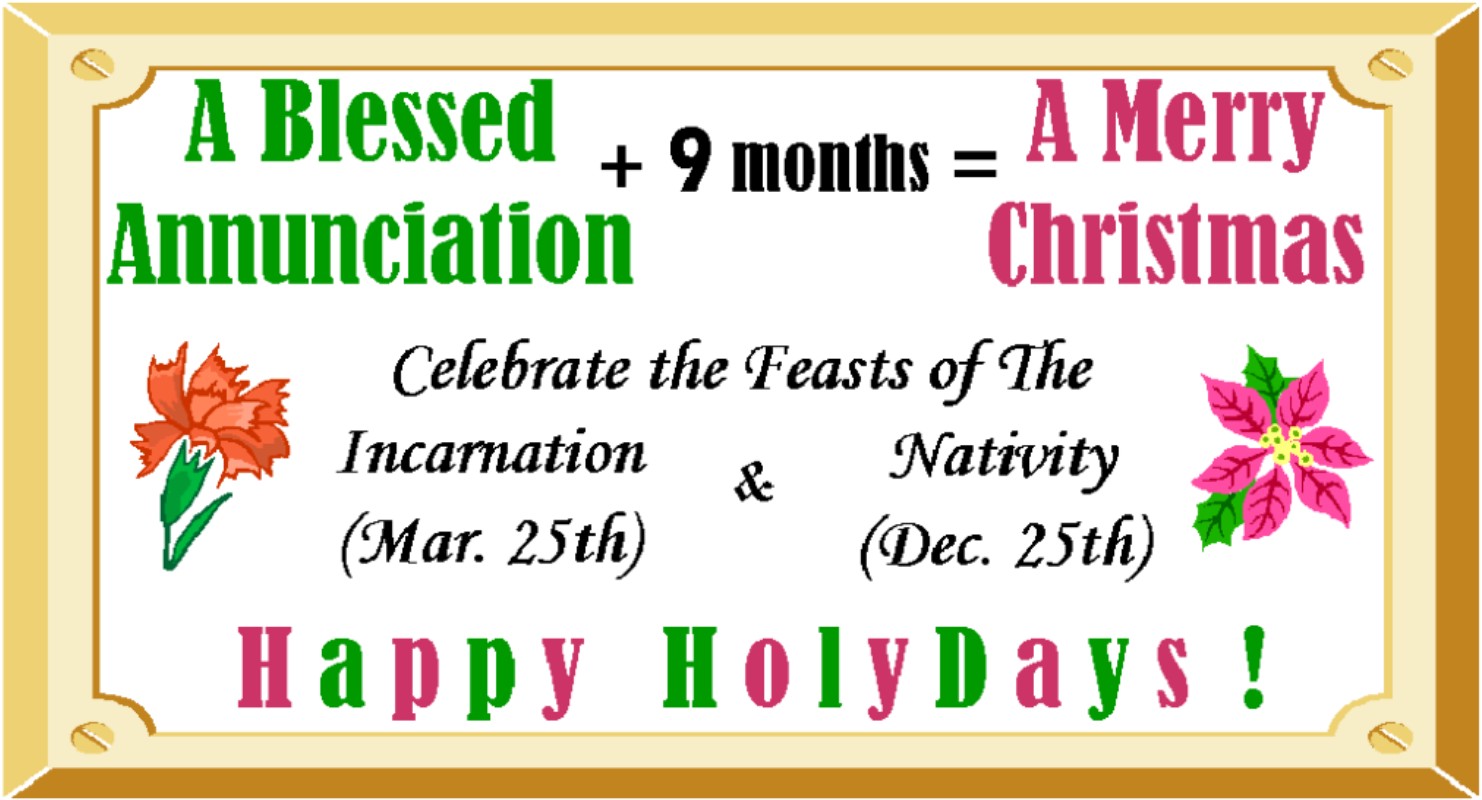
information about the feasts as you like, for ex.--“A Blessed Annunciation
(Mar. 25) + 9 months = A Merry Christmas (Dec. 25)” and a line to connect it to
New Year’s such as “New Year’s was Celebrated on Annunciation Day in the
Pre-Gregorian Calendar” or “The Annunciation Feast of Christ’s Conception was
the Old Calendar New Year’s Day Celebrated Nine Months Before Christmas”--in
addition to being free, other advantages of using an e-mail signature are the
unlimited text and the fact that e-mails often get forwarded.
Click
HERE for instructions on using our
banners in e-mail, blogs, and websites (or printed labels) to show the
Annunciation/Christmas/New Year's link.
Screen Background for Computers/Tablets/Phones to Use During the Holidays
Save one of our Christmas/Annunciation banners like the one above as your screen background for the holiday season. Right-click the banner above to get the menu option to save picture/image (or set picture as background) -- if saving the image choose desktop as the location -- then go to the image on your desktop and right-click to get the option to set picture as background. For phones/tablets touch and hold the banner above to save -- then go to the saved picture and use your tablet/phone's option to set as wallpaper, (which may be a menu option when viewing the saved image, usually accessed by touching or dragging down the upper right corner of the screen). Visit our Web Banners page for additional images to choose from.
Labels/Seals/Stickers/Stamps for Envelopes/Packages
Design
your own labels/stickers and ink-stampers on-line simply by choosing a style
and typing in your text. Address labels
can be personalized with any text you choose at many Internet stationery
retailers -- it's as easy as filling out a web form, and they make attractive
additions to Christmas/New Year’s cards and can be used as envelope seals on
the outside of all your holiday season mailings. You can also use the free web banner graphic above to print your
own larger seals/stickers (Avery 2"x4" for example): To download an MS Word file to print the
graphics right-click HERE to save the
Annunciation/Christmas seals file -- print a test sheet. You can print them on full sheet labels, (a more economical option is the 100 pack Yellow
Back Labels YBL Full Sheet here with yellow backing for
easier printing, also available via Amazon ) -- or for convenient
pre-cut stickers use Avery 48863 labels (carried by Wal-Mart and office supply
stores) or any Avery-template-5163 compatible label -- right-click HERE to
save the version that includes the facts about New Year's Day. It is also fun to design your own at home
with computer inkjet/laser printer labels and a word processing or home
publishing program; this will give you control over the font and design, and
your local office supply store will
have a variety of shapes and styles for you to choose. However, an easier way is to design and
purchase them on-line--many Internet stationery stores allow you to type your
own text into the name and address lines on the screen. Choose styles that allow 25 or more
characters and at least 3 lines.
Note: Depending on the style and
text you choose, the labels can also be used on March mailings leading up to
the Annunciation. A stamper is a more
economical alternative, but ink may not show up well on all paper types. Some examples with suggested text are below:
Stampers:
Though more cost effective than labels, ink may smudge on some paper types and may not be as readable on dark red or green envelopes. If choosing a stamper, consider the jumbo size self-inking with 7 (or fewer) 36-character lines.
Text-Only Labels:
A generous 5-line text allowance is available for
plain white labels. You can type in your own personalization
on-line exactly as you want it to appear.
For a more decorative style metallic foil are available with 4 to 7
lines of up to 40 characters each: Click here for gold or smaller roll
labels can be found in silver and other colors in 4 lines of 28 characters each
at CurrentLabels. Value-priced sets of 200 in a block letter
style with 4 lines of 30 characters each are available from Walter Drake --
click the link for gold, clear and multi-color. (a 4th line of text allows a mention of the
New Year connection--example below).
Also consider the 3-line easy-to-read Large Print labels (for options that include gold
click link) that can accommodate: A
Blessed Annunciation~Mar.25 Plus 9
Months Equals A Merry
Christmas~Dec.25
4-line example
for Christmas/Annunciation/New Year's with 30 characters per line:
A
Merry Christmas~Dec.25
Minus
9 Months Equals
Annunciation
Day~Mar.25:
The
Old New Year’s Day
(or
another 30 character 4 line example~use bottom 3 lines in caps if limited to 3
lines):
GodBecameFlesh~WhenMarySaidYes
A
BLESSED ANNUNCIATION~MAR. 25
+
9 MONTHS =
A
MERRY CHRISTMAS~DEC. 25
(or
a 40 character 4 line example~can use just top 3 lines if limited to 3):
Annunciation
Day/Old New Year's~Mar.25
+
9 Months =
Christmas
Day/Festum Nativitatis~Dec.25
Happy
Holy-Days!
Decorative Labels With
Graphics:
If you prefer a more decorative label with a
graphic, Colorful Images offers many holiday themes including the larger
square shaped style. Most have a 4 line
26-character-each limit. To order just
click on a design below and type the text of your choice into the name and
address boxes after adding the label to your cart.
Graphics that cover both Annunciation/Christmas
include the 4-line 26 character golden bells (also good for New
Year’s).
Traditional Christmas decorative labels include the
4-line 26-character evergreen
border, poinsettia/candles, & angel at the manger.
The more common
3-line 26-character labels can accommodate:
Annunciation
Day--Mar. 25
+
Nine Months =
A
Merry Christmas--Dec. 25
Or 4-line
example:
Annunciation
Day--Mar. 25
&
Christmas--Dec. 25
Are
Exactly 9 Mos. Apart
[A
4th line might include: The
Length of a Pregnancy or Honoring the Incarnation or
Luke 1:15 & 30-44]
Or to stress its
connection to the old calendar:
Annunciation
Day~Mar. 25
(the
old New Year's Day)
+
9 months of pregnancy =
A
Merry Christmas~Dec. 25
Send Ready-Made Annunciation-Theme Christmas Cards, or Design Your Own Christmas/New Year’s Cards, Postcard Calendar Magnets, or Calendar Cards with text on the Annunciation/Christmas/New Year’s connection:
Annunciation-Themed
Christmas Cards:
You
can download and print our two styles of Christmas/Annunciation note/post-cards
from the web banner page. There are also several commercially
available styles of Christmas greeting cards that feature Annunciation
graphics--some art galleries offer Christmas card versions of their
Annunciation artworks via their websites, while larger retailers may offer some
as well, such as the following with the greeting, "May the love of Christ surround you at Christmas and
always". These rarely note the
Annunciation's significance or relation to Christmas, so you may want to use Annunciation-Christmas labels
with these cards, or write your own note pointing out the nine month
Mar.25/Dec.25 interval between the two days.
Christmas
Cards Referencing Christ's Prenatal Life:
(Note
that many Christmas cards are available only seasonally--if not available check
back in autumn).
"Mother
of Life" Christmas cards feature Nellie Edwards' artwork showing an
expectant Mary dressed as Our Lady of Guadalupe and a point of light emanating
from her womb, as well as the artist's "Word Made Flesh" poem about
Jesus' prenatal life -- see the "Mother Of Life" section here at the Further
Reading and Visual Materials page.
One
unusual customizable card features an apropos poem by Rita S. Beer reminding
us that in carrying Mary to Bethlehem the humble little donkey also carried the
pre-born Savior. The set of 20 can be
personalized allowing both card and envelope to include info on the 9 months
from the Annunciation to Christmas--6 lines of 25 characters each for card, and
4 lines of 48 characters each for the envelope. The cards are available at Miles Kimball or at Walter Drake. Use the "Select" drop-down menu to
personalize the card/envelope. You can
see text examples on various card designs at our Facebook page Album for
Christmas-Annunciation cards. For the
text consider: Line1: Annunciation Day Line2: (March 25th) Line3: + 9 Months = Line4: A Merry Christmas Line5: (December 25th) Line6: Happy Holy-Days!
Madonna
House (founded by Catherine Doherty) offers a similar card ("The Donkey
Carrying God" featuring the artwork of William Kurelek) that could be
effectively paired with the labels suggested above; the card’s text reminds us
of Christ's Incarnation in the womb of Mary and His prenatal life by focusing
on the lowly donkey whose "bells were the first church
bells"--"carrying a Virgin who carried God" on the way to
Bethlehem where He would be born. The
entire card quotation written by Doherty (whose cause for canonization is under
consideration by the Roman Catholic Church) can be read on the website -- see
the greeting
card ordering page for Madonna House publications and also the direct ordering page for the cards.
Ready-Made
Specialty Cards to Personalize with an Annunciation-Christmas Greeting:
Another
option is to order attractive specialty cards that can be personalized on-line
-- even though the graphics don't directly reference the Annunciation, your
custom message will. Tri-Fold, 3D or
pop-up cards are likely to be kept as keepsakes and adding an
Annunciation/Christmas message is an opportunity to highlight the connection
each year. Find unique cards that offer
enough space for an Annunciation-Christmas Greeting -- adjust and divide your
message to fit in the text boxes for names/addresses (some cards offer
personalization on the envelope also).
Some of the more clever designs include Z-Fold Nativity cards that are freestanding like the one at
this WDrake link called Nativity Arches (these serve as a paper
nativity scene for those who might not have one and are the type of cards that
are kept and brought out each year, so the Annunciation/Christmas message you
add will be seen every Christmas). You
can also see a preview of how your message will look on that card --
"Select" drop-down menu for both card and envelope personalization,
then click "Personalize" and you will see a sample picture of how
your text will look on the card or envelope.
The Arches card shows a stylized image of the Nativity in a more formal
design and both card and envelopes have a generous text allowance. The card has three 40-character lines that
will accommodate:
Annunciation
Day/Old New Year's~Mar. 25
+ 9 Months =
A Merry
Christmas/Happy Holy-Day~Dec. 25
The
envelopes for the Nativity Arches cards allow an additional and even greater
character count for a custom Annunciation-Christmas greeting that all who
handle the envelope can see, for example:
Feast of the Annunciation/Old New Year's~Mar. 25
+ 9 months =
A Merry Christmas/Feast of the Nativity~Dec. 25
HAPPY HOLY-DAYS !!!
Cards
with 30 character lines can accommodate:
Blessed
Annunciation~Mar.25
+ 9 Months =
Merry
Christmas~Dec.25
Happy
Holy-Days!
Other
noteworthy designs you can customize:
One is the Rita S. Beer "little donkey" card, mentioned in a
previous section. This and several
attractive designs that allow card and envelope personalization are available
at Miles Kimball and Walter
Drake
-- (may not be available till fall) -- use the "Select" drop-down
menu to choose both card and envelope personalization, then click
"Personalize" and you will see a sample picture of how your text will
look on the card or envelope. Another
hard-to-find card has images and text showing God's "Greatest Gift"
in "the form of a tiny baby" resting in the hand of God -- most
versions allow 3 lines, and more on the envelope -- to search for Greatest Gift
cards Click Here or visit this site.
Design-Your-Own
Cards:
Designing
your own cards with or without a template allows the maximum freedom for images
and text allowance for your Annunciation-Christmas greeting. Vistaprint allows you to create your
own cards with the images and text you choose without purchasing a large
quantity. You can design your own from
scratch using their stock of images, or use their templates. They have many Christmas themes and products
that can easily accommodate the text examples for the Christmas/Annunciation
labels given above--for example:
Customized Holiday Cards (regular folded, photo,
and postcard styles) are available in angel or other Christmas themes -- just select type of
card and then choose from many themes and designs and add your text.
Calendar
Cards (Flat Cards, Folded, Magnet-Postcard, or Card-Insert Combo):
Calendar
cards (folded, flat, magnet, or inserts) are ideal for both Christmas and New
Year’s Day and the perfect way to highlight the connection the Annunciation has
with both holidays, serving as a reminder of the feast for the coming year (remember to point out the calendar
connection by adding text on the 9-month interval plus the fact that the March
25 Annunciation was the old New Year’s Day.
Vistaprint
(for maximum options customizing a calendar-card design, including graphics,
font/size and a generous text allowance):
Holiday Calendar Cards (After clicking the link, choose card size, flat or folded style,
and photo options at left. If you
choose the photo option you can select one of Vistaprint's images suitable for
the feast--manger, angels, bells, baby, etc.)
Mailable Calendar Magnet Postcards
(If you don't see a holiday theme you like, choose the design you like best and
then you can change or add graphics when you customize with your text, adding
text lines if needed.) For example, see the festive Glitter dots design or for more text
area the gold chevron
For easier
personalization message see:
Personalized Calendar Cards [may only be available seasonally] These
can also be sent after Christmas as a New Year's Greeting. Easy-to-personalize calendar cards with
religious or seasonal images--just use the signature/names section to type in
your own message. Some have envelopes
that can include an Annunciation/Christmas/NewYear message everyone who handles
the mail will see. Most cards allow
three 30-character lines such as:
A Blessed
Annunciation~Mar.25
+ 9 Months =
A Merry
Christmas~Dec.25
(or)
A Blessed
Annunciation~Mar.25
+ 9 Months = A
Merry Christmas
March 25 = Old
New Year's Day
Stocking Stuffers Personalized with Info on the Feast Days:
Many small items can be ordered with a line or lines of text. One suggestion that’s sure to be a keeper is heat-sensitive color-changing mood pencils--see the following site link with a generous text allowance in quantities of 100 and up can be personalized with 4 lines of text and 35 characters per line (for text ideas see the label suggestions for 3-4 line envelope-package seals/stickers). For smaller quantities, the thermo mood color change pencils may be available HERE in a set of 12 (the 12 set allows only 30 characters) -- if color change pencils are not available there is an eye-catching dozen with holographic stars and easy to read text/background (to save space separate the words with capitalization rather than spaces and write the line equation style to show the interval between feast days).
Some 30 or less character examples:
Mar25AnnunciationDay+9mos=Xmas
Mar25 Annunciation+9mos=Dec25
IncarnationDay+9mos=aMerryXmas
AnnunciationDay+9mos=MerryXmas
AnnunciationDay+9mos=Christmas
Xmas=AnnunciationDay+9
Months
AnnunciationToXmasIsNineMonths
Annunciation2Christmas=9Months
Note
that high quantity minimums of the mood thermo pencils needed for
schools/organizations can be ordered at many custom pencil sites -- sometimes
called funtouchable for the heat-sensitive color change -- these vary in their
text/character allowance.
Give Customized Tree Ornaments as Gifts (with text on the Annunciation and Christmas):
A Christmas
tree ornament has the advantage of being brought out every year as a reminder
of the feast days, and if reasonably durable can be handed down as a
keepsake. Some tree ornaments can be
homemade using the image/text ideas below and those found under the gift tag and envelope seal
sections. However, modern technology
allows you to add your own text on-line to professionally made wood and metal ornaments
that can be given/mailed as gifts. Some
of the metal and fabric ornaments described below are sufficiently flat and
lightweight to be inserted in Christmas cards.
Small to Large Quantity
Personalized Ornaments:
Many sites such as those below allow you to design your own ornament on-line by typing your message into text boxes for various ornament styles--some also allow you to choose a style of lettering.
Small Quantity:
Metal:
If you only need one or a
few consider the ornament styles at Things Remembered site
which allow you to preview how your text/font will look on the ornament -- For example, this filigree heart
--allows a generous 4 lines for your Annunciation/Christmas message, including
special characters like +,=,~. For a
quick look at some photo examples the Ornaments photo album at our Facebook page has samples of how text/spacing variations look on
this ornament. If you choose this style
just click the filigree heart
link and type or copy/paste the text
A Blessed Annunciation~Mar.25
+ 9 Months =
A Merry
Christmas~Dec.25
into each of three lines,
and you still have one remaining line for a family name or additional
greeting like Happy Holy-Days! or Celebrate the Holy-Days! When done, use the preview option in case
you want to add/remove spaces. Note
that adding a 4th line may make all text smaller.
Glass:
Bronner's CHRISTmas Wonderland
also offers traditional ball glass ornaments in many colors that can be
personalized -- click HERE to add
your message -- with only 3 lines of 14 characters each, you'll have to be
creative with abbreviations and eliminate spaces/periods. Try the following:
AnnunciationTo
CHRISTmas=9Mos
Mar.25~Dec.25
Annunciation
&
CHRISTmas
9
Months Apart
2
Days 2 Honor
9
Months Apart
Mar.25/Dec.25
Medium Quantity: Wood is a good option if you need more than
a few and want to send one to family, friends, or everyone on your Christmas
card list. LazerDesigns offers several
styles of wood ornaments that you can personalize with your own text. They are laser cut and engraved with your
message and each comes in a gift box with string to hang--production time is
5-10 business days, and any quantity can be ordered from one on up--the greater
the quantity, the lower the price per ornament -- see examples below:
Most appropriate is the angel design which covers both feasts
and allows 4-lines of 25-characters each--you simply click the button to
personalize and enter your desired text in the line boxes.
Here are some text suggestions for four
25-character lines:
ANNUNCIATION DAY--MAR. 25
(the old New Year’s Day)
& CHRISTMAS--DEC. 25
Are Exactly 9 Mos. Apart
INCARNATION & NATIVITY
Annunciation Day--Mar. 25
& Christmas--Dec. 25
Are Exactly 9 Mos. Apart
There is also a star design with 4 lines of only 20
characters each.
Here is a text
suggestion for 20 character lines:
Blessed Annunciation [or]
Annunciation Day
+ 9 Months =
A Merry Christmas
March 25~December 25
Large Quantity & Flat
Mailable:
Individuals
and organizations needing larger quantities of customized ornaments have
additional options.
Wood can be purchased through the links above. For mailable ornaments thin enough for an envelope, fabric
ornaments may be available at some promo/custom sites, but will be less durable
over the years. Thin metal ornaments
can fit in a Christmas card envelope -- for examples: see the
Shining Star ornament easy to personalize as it
will look elegant with plain black text, or the Star Holiday Ornament which is 3-D but mails flat,
and the gold filigree Express Holiday Star Ornaments
-- for the latter two you may want to choose Red text for a festive look on a
standard white background and then type the message you want, or you can upload
a colorful graphic image that includes text.
Evangelize with a Christmas/Annunciation Shirt or Pin Badge to wear for the Season:
Design
a Christmas/Annunciation theme tee/sweatshirt, pin badge, key chain/pendant and
wear it for the holiday season. These
wearable tools for evangelization can also be given as gifts. Pins can be worn on a coat in cold
weather. For the shirt you can use
iron-on printer paper or fabric paints to do it yourself, or have one made for
you (online or at mall airbrushing kiosks), or design it yourself at Vistaprint. Badges can
be made easily with do-it-yourself snap-together clear pin buttons (or even the
common rectangular fold-over ID pin badges ideal for a children's
project). For maximum impact extra
large 3-1/2 inch clear round snap-together badges that require no button machine
are available at this site and also at here this link -- they are sold by the piece at some craft stores
like Michael's. The same style of
snap-together buttons can be found in a smaller 3-inch size at this link. Clear insert key-chains round or rectangle can be converted to
pendants with a cord--for these and other clear insert-items in various shapes
and sizes visit your local craft store or -- click
here for rectangles and round shape keychains --and here for more clear snap together items.
These
also can be given to pro-life prayer groups at the start of the Christmas
season. For shirts and badges designs
should be simple but festive. Dark red
and green lettering can alternate with black.
If you plan to wear it in March for the Annunciation as well, consider a
gold/silver color scheme. A small
graphic such as a star, angel, dove, bells or carnation/poinsettia can be added
for visual interest. Glitter, metallic,
or opalescent fabric paint can add emphasis to shirts printed with iron-on
sheets. Text should be simple and
attention getting (curved text for the first and last lines works well with
round badges). For example:
March
25
Annunciation
Day
+
9 Months =
A
Merry Christmas
Happy
HolyDays!
Homemade Gift Tags (children/young teens):
(Note: For quick and easy flat-style gift tags
print our dual-season Annunciation/Christmas "Happy HolyDays"
stickers/labels using cardstock or heavy paper -- then cut, punch a hole in the
corner, attach string, and write the name on the back -- CLICK HERE for
the graphic and download link.)
Homemade
Annunciation/Christmas theme gift tags are a good craft for children who can
either draw/color the pictures or cut them out of catalogs/magazines--sticker machines
are helpful for a mini collage. (Older
children and teens can do these on a computer with clip art.)
You will need card stock or heavyweight paper
and a hole punch and string for the corner.
(For a smaller hole try a 1/8 in. scrap-booking punch or a thick needle
threaded with string or ribbon). Simply
cut a long rectangle twice as long as the finished gift tag should be, and fold
in half. For example, a standard 8 1/2
x 11 sheet will produce 6 tags large enough for a small drawing or collage--cut
the sheet in two 5 1/2 x 8 1/2 halves, then cut each half into thirds 5 1/2
x a little over 2 3/4.
Then fold strips in half--tags will be
squarish in shape. With the fold at the
left, punch a hole in the upper left corner.
On front of tag, write or paste a cut-out
“Merry Christmas” at the top, and then “from:” below that, and “to:” near the
bottom--leaving space to fill in names later.
Open tag (there will be two panels). On the left side write at top: “Annunciation Day” or “Feast of the
Annunciation”, and on the right side across from it write “Christmas” or “Feast
of the Nativity.” (“Feast of the
Nativity” is a much older name for Christmas).
Then near top under the feast names write “Mar. 25” on the left, and
“Dec. 25” on the right, across from each other--then in the middle between the
two dates write “+ 9 months =” or “plus 9 months equals” (this should be
written across the fold).
Then draw or paste small pictures of the Annunciation
on the left (Mary with angel, Mary with halo around her womb, rays of light
coming from dove down to Mary), and of the birth of Jesus on the right (manger,
holy family, star, sheep). When done
children should sign their tag on the back after “made by” and add the
year.
Then close tag and feed string or decorative
cord or ribbon through both holes in corner and tie with a double knot so that
loop is at least 4 1/2 inches long (long enough to attach to gift bags by
wrapping the string around handles and feeding card through loop and pulling
tight).
Mini Gift Calendars Personalized With Info on the Annunciation:
In
each Christmas card you send, insert a customized wallet or desk size calendar
for the coming year. As noted in the
section on Calendar Christmas Cards/Postcards,
a calendar that will be kept through the coming year is ideal not only as a
continual reminder, but the calendar theme lends itself to info on the feast
dates, the nine month interval, and the fact that the Annunciation was New
Year’s Day in the pre-Gregorian calendar (until the 1700s in England). Any or all of this information can be
included on a small calendar. You can
have them professionally printed, download ours (the coming year is uploaded in
November), or make them yourself, as explained below:
NEW:
An HTML Version of Mini-Calendar Opens/Prints In Your Web-Browser
An
Easy Way to Highlight the Annunciation/NewYear-Christmas Holy-Days Connection: Share these full-year calendars with feast
day reminders -- post/tweet them online or print them out. One-Sheet version as well as 4-per page mini
version -- for more see the home
page:
(OR)
Download
Our Pocket-Size Calendars:
You
can download and print our credit-card sized cards--a new calendar is uploaded
in November in time for Christmas mailings.
They can be printed one-sided, and you can sign the back with a personal
greeting to each recipient; or, you can print one of the optional back sheets
that has additional info on the feasts of the Annunciation and Christmas (with
a carnation and poinsettia graphic) and either a blank space for your own
greeting or our dot.com URL address. Note: If you choose to add your own greeting in MS
Word, download the blank-space backing file, open the file with Word and
double-click the calendar image in the document --there is a text box in edit
mode (between the flowers) that you can personalize with your name, recipient's
name, year, etc.--remember to close the picture after editing and to save your
changes. Print in color on best quality
setting and try a coated heavyweight paper for best results (photo paper,
smooth cardstock/greeting card paper, or heavyweight graphics/imaging
paper). Right-click the following three
links to save and print our
business-card-size pocket calendars and optional dot.com
back or optional blank-space back -- or the following for larger wallet-size mini
calendars which also have an optional dot.com
back wallet size or blank-space back wallet size. (The calendars can also be used in March as enclosures if you
send Annunciation cards -- Greeting
Cards with a Carnation theme for the Incarnation or Cards with a traditional
Annunciation theme.
Professional
Printing:
For
large quantities (usually over 50) you might visit an office supply store in
person or on-line to have standard business card stock professionally printed
with any text you desire on the front and the calendar on the back.
For
small quantities:
Single
sheet self-stick calendars are available with a text allowance of 4 lines of 34
characters each -- (set of 100 in burgundy) -- text example:
A
Blessed Annunciation~March 25th
(plus
9 Months equals):
A
Merry Christmas~December 25th
Happy
HolyDays from The Smiths
A more
durable option is the set of 50 plastic credit-card size calendars in matte finish -- up to 28 characters for
the first all-caps line and 32 max each for lines 2-4 -- text example:
TWO 25THS TO REMEMBER
IN MARCH & DECEMBER
Annunciation~Mar.25~Old
New Year
+9 Months=Dec.25~Christmas
(or)
25THS TO REMEMBER
IN MARCH & DECEMBER
THE SPACING WAS SMART
THEY'RE 9 MONTHS APART
(or)
REMEMBER THE 25TH
OF MARCH & DECEMBER
Learn It By Heart
They're 9 Months Apart
(or
to personalize it with your name):
CHRISTMAS MINUS 9 MONTHS =
?
Annunciation Day!~March
25th
The Pre-Gregorian New
Year’s Day
Happy HolyDays from Jan
& Frank
(or)
CHRISTMAS
– 9 MONTHS = ?
March 25~Annunciation Day
(The
Old New Year’s Day)
Happy
HolyDays
CHRISTMAS
– 9 MONTHS = ?
March 25~Annunciation Day
(The
Old New Year’s Day)
Feast of Christ’s Conception
May
the Blessings of March &
December
25th be Yours
NEW
YEAR’S DAY IN MARCH?
Christmas
Minus 9 Months =
Mar.
25~Annunciation Day!
Pre-Gregorian
New Year’s Day
Feast
of Christ's Conception
&
Day of the Unborn Child
MARCH
25 ~ DECEMBER 25
Nine
months before Christmas
is
Annunciation Day (Festum
Incarnationis
/ Conceptio
Christi)--the
pre-Gregorian
New Year’s Day until c. 1700
TWO 25THS TO CELEBRATE !
IN MARCH & DECEMBER
A Blessed Annunciation Day
+ 9 MONTHS =
A Merry Christmas
HAPPY HOLY-DAYS
A BLESSED ANNUNCIATION
+ 9 MONTHS = CHRISTmas
The feast of Christ's conception &
Incarnation was the pre-Gregorian
New Year's Day--9 mos. before Xmas
March 25th-Annunciation Day!
Make
Your Own:
If
you want to include Annunciation/Christmas theme calendars in Christmas
mailings every year it might be worthwhile to learn to make your own--many home
publishing programs have calendar options--the graphic options for calendars
are linked to programs that calculate the days for whatever year you
enter. Your program may give you the
option to choose a small calendar (pocket or desk size), and most have full
sheet options. Full sheet calendars can
be printed from the home publishing program.
For mini-calendars you may have to copy/paste your calendar into a word
processing program, as follows. Once you
have the calendar formatted the way you want (adding your text at top and
bottom, font changes, etc.) you can copy it as an image. First you may have to click and drag around
the whole calendar to group the months and titles as one image (a single red border
around them all shows they have been grouped), and right click to copy. Then tile it across a blank document in your
home publishing or word processing program to print out several per sheet, on
smooth card stock, greeting card, or photo paper. You can sign the backs with a personal greeting. A standard sheet can easily accommodate 8
credit card size calendars in two columns of four. Or for a tent style desktop size calendar you would divide a
standard size document into four sections from the top down--a sized-to-fit
calendar can be copied into the 2nd section and the 4th at the bottom; then
print and cut the sheet in half crosswise, cut off the blank edges, fold each
in half and you have two stand-up calendars.
However you size and print the copied calendar, remember to keep the
original calendar (original size but with your additions) as a home publishing
file that is still linked to the calendar program--then you can just update it
every year by entering new dates (to change the date in the saved file, some
require you to enter the new year separately for each month). Note:
The top line of your calendar should include a catchy slogan--for
example, “A Blessed Annunciation
+ 9 months = A Merry Christmas“
-- with additional facts on the feast on the bottom or back. Also, the 25th of March and December can be
highlighted in a red font or with red circles.
Clergy and the
Christmas Connection (see also Spiritual
Adoption):
The
most natural way to introduce the Annunciation as the occasion of Christ’s
Incarnation and conception is in a Christmas Eve or Christmas Day
sermon/homily, which reaches the greatest number of people because of increased
attendance. But any Sunday during the
holiday season is a good time to touch upon the history of the Annunciation
feast date and its relationship to Dec. 25th.
Those who want to comment on the pro-life import of Christ’s Incarnation
can point out that the contemporary observance of the “Day of the Unborn Child
“ takes place exactly nine months before Christmas on the traditional day
commemorating Christ’s conception--March 25th.
It needn’t be the focus of the whole sermon--just a brief comment to
address the subject takes only a few moments.
Additionally, the large public space available in a church can be
utilized with a banner conveying a simple message such as: “A Blessed Annunciation + 9 Months = A Merry
Christmas” and/or “Celebrate the Incarnation & Nativity--March 25th &
December 25th--Exactly Nine Months Apart". Any one of these approaches can make an important contribution
toward fostering not only our reverence for life but our understanding of
Christology and the Incarnation--for this single reference in church on
Christmas may be the only time Christ’s conception is brought to the attention
of the congregation, especially those who come only once a year.
[Note: Catholic clergy in particular have an
additional opportunity during the Christmas season to mention another
pregnancy-length interval between a conception and birth feast. As with Christ's conception and birth, the
feast of Mary's conception on December 8 is set nine months before her birth
feast on September 8. The consistency
in the symbolic spacing of these two pairs of dates is something that can be
brought out in the homilies for each of the four feast days. There is yet another advantage to explaining
the March 25th Annunciation on the feast of Mary’s Immaculate Conception and
visa-versa--pointing out that there is a specific feast for Christ’s conception
(logically set nine months before Christmas) clarifies the fact that the
December 8 Immaculate Conception commemorates the day Mary was
conceived--many people confuse the Immaculate Conception of Mary with the
virginal conception of Christ.
Confusion is apt to occur because the absence of biblical references to
Mary’s parents necessitates the reading of the Annunciation passages concerning
Christ’s conception on the feast of Mary’s Immaculate Conception, and there is
also the less frequent but additional complication of some denominations’ use
of the term “Immaculate Conception” to refer to Christ’s conception. Clearly we can be using the same language
but meaning something entirely different.
Each of these gestationally spaced feast dates is a welcome opportunity
to set the record straight, and if we are directed to keep the nine month
interval in mind, it is easy to understand which conception feast is for Christ
and which is for Mary--because we all understand Christmas as commemorating
Christ’s birth.]

Carnations for the Incarnation:
The Need for A Symbol:
The
all-important moment of Incarnation--the central theme of Christianity--is
often left out of depictions and discussions of the Annunciation, because it
takes place hidden in the womb of the Virgin Mary on a scale too small to be
seen. Even eyewitnesses standing by at
the Annunciation could not say they saw the Word become Flesh, and artists who
try to represent this real event by painting a window on the womb can only
effectively show a later stage of prenatal development, not the microscopic
level of conception. It is easy to
visualize the angel and Mary or a dove floating above representing the Holy
Spirit, but the embryonic Christ concealed in the womb of the virgin is a
challenge for our imagination; it is a challenge even to imagine friends,
family, and other ordinary human beings at this prenatal stage of life--how
much more challenging to imagine God as that tiny embryo. “Out of sight--out of mind” is often equally
true of the mind’s eye, especially when the pivotal fact of Christ’s conception
can be overshadowed by beautiful mental images of the archangel Gabriel we can
so much more easily visualize. For this
reason there is a need for an abstract symbol not native to the oft-portrayed
scene, but clearly referencing that most momentous event there taking place.
The Flower as Symbol:
The beauty and fragrance
of flowers and their varied types make them natural symbols. From the time of the ancient Greeks through
the Victorian era, flowers have been used as a symbolic language or
“florigraphy.” Holidays (or holy days)
and observances often have specific flowers associated with them. Christmas has the poinsettia, Easter has the
lily, and pro-life Roe v. Wade memorials use the rose, but a visually appealing
symbol is particularly important when illuminating an unseen mystery. In this case, it is the unique and
unparalleled moment of Incarnation--the conception of Jesus--which,
paradoxically, takes place in the material world but cannot be seen by man and
remains hidden for nine months. The
carnation is a much-needed and welcome symbol that in its very name focuses the
mind on what happened on that awe inspiring occasion.
Carnations for the Incarnation:
The literal translation
of “carnation” is a “flesh-colored” flower--making it an appropriate symbol for
the enfleshment of the eternal Word even if it were not a near sound-alike for
the theological term. Dianthus, its
aptly named genus, means "divine flower" or “flowers of god.” But one needn’t know any facts about the
flower to make the connection with “Incarnation”--these nearly homonymous words
were once synonymous for a rosy hue--and the association between the two comes
quite naturally. In fact, when the U.S.
Postal Service revealed the name of the artwork featured on the 2007 Christmas Stamp
-- Bernardino Luini’s "Madonna of the Carnation"--some assumed a printer's error cut the "In"
off the last word of the title (the cropped image on the stamp made it hard to
recognize the small flower in the hand of the infant Christ). Art aficionados may have recognized the work
as one of several identically titled paintings by famous artists like Da Vinci (see detail) and Dürer depicting Mary
and the baby Jesus holding the beautiful blossoms as in this alternately titled
painting by Bergognone. In the past, carnations have had various
meanings, including maternal love, and the points or “pinks” of the petals were
used as symbols of Christ's Passion--the carnation therefore also has the
advantage of representing Christ’s entire earthly life from virginal conception
to his redemptive death. Moreover, once
established as a well-known symbol, this common florist-flower seen year-round
can serve as a frequent reminder of Christ's incomparable gift of Himself in
the flesh.
General Suggestions on Using
Carnations:
Carnations
present us with many lovely ways to make a poignant memory on the feast day--in
the form of a thoughtful gift, beautiful bouquets in church, a single bloom on
the dinner table, or worn as a boutonniere by both men and women. They come in a wide variety of colors, from
the plain white you find at the florist to the Black King carnation with petals so darkly red they appear
velvety black. As symbols of the
Incarnation, keeping in mind the meaning of the words, flesh-toned
carnations (rose, pink, and peach pastels are the most common) are preferable
to the more bright purples, red/orange, and striped varieties. Click to read more about our downloadable “Carnations for the Incarnation” paper ribbons,
which can be attached to the stems to highlight the symbolism. For an emphasis on the pro-life aspect of
the day, use the smaller baby carnations, or a mix of pink carnations and white
dyed blue (click for instructions). Artificial carnations are especially useful
for crafts--they may be easier to find and far more affordable at dollar and
discount stores than craft/party specialty stores. See the suggestions below for specifics on using the carnation
theme in particular Annunciation feast activities and settings, including the church, parish, and school; ideas for the home; organizations or families hosting a dinner/party/tea/event; baked-goods and candy; gifts and party favors; crafts for adults and children, and cards/invitations, envelopes and seals.
Carnations in Church, Parish, & School-Based Activities:
Bouquets and Arrangements in Church:
Flowers
have long been used in church as examples of the beauty of God’s living
creation. Use carnations prominently in
church on the feast day or on the Sunday before or nearest the feast, with
clear mention of the symbolism and the day’s significance.
Flowers in Processions:
For
example--on the feast day, have a first communion class enter church in
procession holding carnations.
Faux Carnation Lapel Pins--With Ribbons Imprinted With Feast Date Info (for distribution at church/school, or given as gifts):
The site www.wrapwithus.com has
fabric carnation pins in several colors with ribbons that you can personalize
with your own message.
“Incarnation Celebrations” (use the carnation as a symbol in promotional materials):
Annunciation
events that focus on the Incarnational reality of Christ’s conception are
sometimes called “Incarnation Celebrations”--carnation graphics can be used in
fliers, signs, and bulletin inserts promoting the events.
Carnation Sale Fundraisers:
Celebrate
the feast by having a carnation sale fundraiser with a portion of the proceeds
benefiting a local pro-life pregnancy center.
Fundraising carnation sales for churches and charities are often
promoted as Carnation Day, but the practice can easily be applied to the
celebration of Incarnation Day to reinforce the meaning of the feast and raise
money for a worthy life-affirming cause.
Click here
for general info on having a carnation sale. Contact your local nursery or florist for flowers, and offer to
place their name on the order forms in return for a discount. Promotion of the sale should stress the
carnations are being sold for the Annunciation feast of Christ’s Incarnation
with proceeds going to a pro-life pregnancy center in memory of that moment of
His conception--Right click here to
download/save a promotional sign with this info and carnation graphics
(standard size
sheet--print best quality color in landscape).
Carnation Seeds (for distribution at church/school, or given as gifts):
Though they lack the visual appeal of the
flower, carnation seeds are the ideal symbol of the Incarnational conception of
Christ--a seed represents new life, and the blessing of seeds is an old
Annunciation Day tradition. Their small
size brings to mind the embryo--the tiny plant embryo hidden within the seed
coat as the newly conceived Christ was hidden in Mary’s womb. Right-click to save our "Carnations for the Incarnation"
color sheet (with the feast name, date, etc.) which can be cut and folded into
four mini seed packets, or into paper ribbons to staple to clear bags/packets
if desired--see instructions below (for printed fabric ribbon see Give Fresh Flowers section). A standard carnation seed packet from a
nursery or home store is enough for 10 or more mini packs--a small pinch a
pack. For larger distribution, bulk carnation
seeds can be purchased on-line in a multi-color mix at neseed.com
(various quantities--1/16 oz. to 1 lb.).
For other color varieties and quantities check edenbrothers.com,
which sells in small packets or by the ounce.
Instructions for Making Seed Packets:
Right-click
the link to save and print our standard size color "Carnations for the
Incarnation"
sheet (one sheet makes four packets).
Cut the sheet in four 4 1/4 x 5 1/2 in. quarters. Place one of the quarter sheets long-side
vertical, so that the writing is right side up as for reading. Flip it sideways so the printing is face
down. Fold up from bottom in half (half
the printing is now visible upside down).
Then fold right edges up about 1/2 in. and crease down toward the
center--do the same with the left edges.
Then fold these right and left folded edges in again toward the center
so they almost touch in the middle.
Crease all folds tightly. The
side facing down should now have a pocket about one-and-a-half inches wide--put
a small pinch of seeds in the pocket (enough to rattle--at least 7). Then with folded side facing up, fold the
top down about 1/2 inch and crease the several layers tightly especially at
corners. Flip packet over side-to-side
so smooth side is facing up, and staple near top centered about 1/4 inch down
to secure flap.
If Clear Seed Packets Are Desired:
Clear
mini bags that show the seeds can be purchased at craft stores or Internet
sites. If they are not the zip lock
type, remember to fold each top corner in to create a point and then fold
pointed top down and staple.
Transparent packets can also be made with tracing or wax paper by using
the folding instructions above for regular printed sheet packets. If using printed paper ribbons below, attach
with the one staple used to close packet.
To attach paper ribbons with feast info to clear packs: Right-click the link to save and print our
standard size color "Carnations
for the Incarnation" sheet--but print it double-sided. Cut sheet in half lengthwise into two 4
1/4 x 11 strips. Cut 4 1/4 strips wide enough to read three
or more of the repeated lines of text--about 1/2 inch wide. Fold strip in half at an angle to create a
V-shape, and staple near top of packet (if using folded tracing/wax paper
packets or non-zip-lock plastic, use the one staple to close packet and attach
ribbon). (If desired, you can cut white
edges off each side of sheet after printing, or for a more finished look, you
can cut ends of ribbon on a bias after cutting each strip). [NOTE:
this same downloadable sheet can be printed double sided and used to attach longer ribbons to fresh cut
carnations--click for instructions.]
Carnations for the Home and Family
Dinner Table:
The
most common suggestion for using carnations on the Annunciation is to have
fresh cut flowers for the dinner table.
Most everyone can buy a single carnation for the occasion, and take a
few moments to say a special grace before the meal thanking God for the
incomparable gift of His Incarnation and asking him to protect unborn children. Pro-life organizations such as American Life
League recommend making
a carnation centerpiece for a more formal feast-day family dinner -- League
click here to read the archived article. Women for Faith and Family has an Annunciation webpage featuring
an Activities With Children section that also suggests
using carnations in a household shrine -- explaining to children that they
symbolize the Incarnation and allowing them to sprinkle the flowers with holy
water. EWTN’s web page on celebrating
the Annunciation includes these and adds info on the meaning of the carnation
as symbolic of the Incarnation, life, love, and the crucifixion. Note: Instead of
throwing faded flowers away, remove the freshest most colorful petals and press
them flat--use as confetti in or to make pressed flower Incarnation Day
greeting cards to send next March--see section on Carnation-themed Greeting Cards.
For
dinner parties, see the suggestions for a carnation-themed
event/diner/party/tea below.
Families & Organizations: Host an Event, Dinner, Party, or Tea with a Carnation Theme
Invitations
can be sent with a carnation theme including carnation confetti inside--see cards/stationery. Please also see the favor suggestions under gifts, and
the dessert ideas in the
baked-goods/candy section. Many carnation
design party items including invitations can be found/personalized at the
link here.
Centerpiece Options:
Fresh
Flowers:
Use
a vase of fresh cut carnations, and offer one to each of your guests to take
home as a reminder of the feast day--you can also attach paper “Carnations for the Incarnation” ribbons
(click for more info) by downloading our color printed sheets (for
printed fabric ribbon see Give Fresh Flowers
section). For a more formal table, order or create
your own carnation florist-style arrangement.
Mini
Carnation Cupcake Bouquet Centerpiece:
Use
the instructions for making carnation cupcakes here but use mini or even
smaller "Cutie" sized cupcakes.
Use pink or peach frosting, and if desired, green cupcake cups (if
unavailable in a mini size you can tint white cake batter green). Instructions for assembling cupcakes into a
bouquet can be found on various websites -- for an example click here. Stems can be green toothpicks
(extra long), b-b-q sticks, straws, chopsticks, stirrers or swizzle sticks
(wooden sticks can be tinted green with food coloring). You can use regular size toothpicks with the
extra small cutie cupcakes (the size of a quarter) -- click here to see the Mrs. Fields
Cutie Cake Pan. For small gatherings
make sure you have at least one "flower" cake for each guest's dessert. For larger groups one bouquet can be
centered with individual carnation cupcakes arranged around it on the
table. Fresh carnations also make a
lovely addition.
Molded,
Floating, or Fragranced Carnation Candles:
Floating
carnation-shaped candles in a clear bowl (using cut crystal reflects the light)
will create a lovely atmosphere, and they can also be given as gifts and favors
-- click the following links to see options:
Reasonably-priced small floating carnation candles can be purchased in various
colors, including peach, on-line. Those
who prefer the fragrance of carnation can choose a scented
jar candle -- there are several stores that have it in various forms (pillar, jar, gel) --
a variety of click here for a variety of pink scented carnation candles also available. If many small favor-sized scented candles
are needed large quantity small votive carnation scent candles (choose carnation scent and
desired color and shape from their drop down menus--you can also click the
option to add personalized
labels and tags and add the "The Annunciation~Feast of the Incarnation" and
any additional lines as space permits ( Mar.25~9 mos. before Christmas, The Old
New Year's Day, Christ's Conception, The Word Made Flesh, etc).
Flowering
Carnation Tea:
For
a unique potable centerpiece, consider a “flowering” carnation tea--see details
under Afternoon or After-Church Tea.
Novelty Stemmed-Carnation-Soaps
Favor Bouquet, or Basket of Molded Soaps:
Stemmed
carnation-shaped soaps in a vase make a fun centerpiece that can be divided
among guests as take-home gifts. A bouquet
of up to 12 soap carnations can be ordered on-line in a choice of colors. Larger quantities of the carnation soap with stem can be
ordered for less per piece -- note price comparisons for wholesale. Basket of Colorful Carnation Soaps: A basket of pretty molded carnation soaps
makes a lovely centerpiece and provides take-home favors. They can be displayed in a basket or clear
bowl or scattered among greenery on the table.
See a selection here or view the examples
at etsy .
Molded
Carnation Candy Mini-Favor-Bouquets:
Stemmed
carnation candies can be used as mini bouquets in bud vases. See the section on candy making.
Setting the Table:
Napkins/Plates:
If cloth
napkins are used, tuck a small carnation (real or faux) into each napkin
ring. You may also be able to find
carnation themed paper napkins and plates for more informal gatherings.
Carnation Petal Confetti & Dried or Preserved
Flower Heads:
Artificial
carnation leis or dollar/discount store carnations can be cut into wedge shaped
petals and scattered on tables or put in carnation-themed party invitations--also
available in jumbo size with larger petals HERE and also at this site. You can
also use real petals. Wedding supply
stores sell freeze-dried carnation petals, in addition to whole dried carnation flower heads -- or preserved carnation flower heads -- but a le a less
expensive option would be the Internet tea supply stores that sell which dried
carnation petals, which may not be as well preserved in shape or color --
better yet, press/dry your own carnation petals.
An Afternoon or After-Church Tea:
See
the general dinner/party suggestions above, but
note that refreshments for teas are usually light, and can range from tea with
muffins to a light lunch of salad, mini-sandwiches, and dessert. If you will be having dessert, see the baked-goods/candy section. For a children's tea party consider using
side view carnation fondant cutters to make carnations out of pink/peach or red
jello -- just do a shallow pan and when fully set cut the side view flowers out
and arrange on plate with sprig of edible greenery (the link to the side-view
cutters is halfway down the paragraph Decorate
a Special Cake). Mini bouquets of baby carnations are charming on the
table. Have a variety of teas including
flavored. For a more exotic beverage as
well as a striking centerpiece, consider a “flowering” carnation tea steeping
in a glass teapot, described below:
Flowering
Carnation Teas (for drinking and display in clear glass):
Flowering
or blooming teas feature a compact bouquet of long tea leaves with a dried
flower in the center that opens in the hot water--these are usually white or green
teas which allow the flower to be easily seen.
They can be served as a beverage and/or enjoyed as a display centerpiece
in a glass teapot, brandy glass, or other clear container. Another harder-to-find option is “tethered”
flowering carnation tea--these are on a string and steeped like a tea
bag--suitable for small clear pots or clear cups (one is strong enough for a
few cups). To view some options click here. A
peach-color carnation is available in a box of Carnation's
Love Blooming Tea -- another similar color is Carnation Immortal Peach Blooming Tea. For a red flower try Red Song blooming carnation tea available at
this Amazon link and more on-line merchants here. If you
just want to try one or two, you can buy Red Song blooming carnation teaposies
by the piece--click here then scroll down and select from the drop down menu or go to the Teaposy
website. [Note that not everyone likes the flavor of
blooming teas (almost always green or white tea with floral or spicy flavor),
so have regular black tea available as well to serve -- even if the flavor of
blooming carnation tea is too exotic for guests it will make a lovely
centerpiece for the table].
Baked-Goods & Candy: (Cookies, Pastries, Chocolates & Mints, Cakes):
All of the following make thoughtful party treat/favors, packaged gifts, or desserts.
Cookies:
Make
carnation cookies with your favorite cut-out recipe or with any round
cookie. Quick method: Use round store bought or ice-box cookies
cutting off round slices to bake--then frost with canned pink frosting (or white tinted peach with
food color) and
use a fork to lift up spiky peaks in the soft icing (also works for
cupcakes--use green baking cups)--see Facebook
page
photo section for pictures. Note that with this method
they cannot be stacked for transport or gift-packs and are hard to write on
with icing. (If these are for parties/events use real or
faux carnations on the display table, and a Feast of the Incarnation sign to
include info on the feast day--right click to download and edit the text of our flower
graphic carnation sale sign.) For
stackable cookies with feast day info written on them: The spiky pattern must be pressed into
the cookie to create a flatter surface:
Use round, or for best effect crinkle/fluted edge or flower shape
cutters with 10 or more short scallops.
Then choose a non-spread cut-out recipe that holds form, and in the
creaming butter stage add food color to tint batter pink or peach during mixing
(if doing two batches, consider leaving one un-tinted for contrast in
presentation). When cookies are cut out
and placed on baking sheet, use a small fork with tapered teeth (narrow pickle
fork, or for large cookies a spork) to press the spiky petal points into the
dough at an angle in a spiral pattern from center outward--press firmly enough to
create pattern that will hold during baking but without flattening or deforming
round shape. To preserve color do not overbake or brown
top or edges. When cool use white
writing icing or easy food coloring markers to add text around the edge: Mar. 25 on medium size cookies, and Incarnation
and Xmas-9 Mos.=? or 9 Mos. Before Xmas on the largest
cookies. For fully-frosted
cookies with text: Bake plain
un-tinted un-patterned cookies and press spike pattern into flat icing instead
of unbaked cookies: Frost the top
smooth with pink cookie icing, wait till it is semi-hard and gently press the
tip of small fork or spork into firm frosting in a spiral pattern as described for
pressing pattern into dough--since frosting is the last step you can press the pattern into icing
more lightly than into unbaked dough (which can more easily lose an imprint). Then write around the edge with white icing.
Note
that if these cookies are displayed on a large plate or tray, not all have to
have the text--just a few of each, and if given as homemade packaged gifts just
one of each will do. [NEW: For side view carnation cookies
you can decorate with green for the base and another petal color icing,
consider this cookie cutter style carnation set for fondant flowers -- (the
largest being 6 x 7 cm) -- see it here. Also NEW
is another side view carnation cookie cutter and stamp set that allows you to make unfrosted cookies
with a carnation embossed imprint on top in addition to the shape from the
cutter -- just choose a cookie batter that holds its shape well]. Fluted or scallop edge cookie cutters like the ones at this link work well for round
top-view carnation cookies. For the
largest cookies (that can accommodate the most text), try large biscuit/cookie
cutters (3 to 5 in. diameter) --particularly those with a zigzag or rippled
"crinkle" edge like this extra large carnation cookie cutter or see those pictured at this link. Williams-Sonoma stores have a set of fluted round decorative
cutters that will work for cookies as well as biscuits. Other Internet merchants offer the set of 6 fluted cutters (2
to 4 1/2 in.).
Pastries--Cupcakes, One-Serving Cakes & Bite-Size Cakelets for Dessert: Buy or Make Your Own
To
make your own, bake cupcakes using green paper baking cups; then frost with
bought or homemade pink/peach icing and use a fork to lift up spiky peaks in
frosting like carnation petals--see frosting tips in carnation
cookies section and the Facebook
page
photo section for pictures. The Wilton site has instructions for mini carnation cupcakes with a 3-D flower on
top. You can also make mini or cutie size carnation
cupcakes and assemble them into a bouquet with at least one "flower"
for each guest's dessert -- see the instructions here under centerpiece options. You can also buy Royal Icing Carnation
toppers for your unfrosted mini cupcakes at this link or at Etsy (choose color with drop-down).
To buy
ready-made carnation desserts, note that many bakeries specialize in theme
cupcakes -- you may find one locally to make them in whatever color and flower
you prefer. Otherwise you may be able
to find a bakery online that ships (but remember they are fragile items) -- click
here
and scroll down the current options.
Carnation-Themed
Chocolates & Mints (purchase or make your own):
Purchase
Chocolates Online:
Carnation-shaped
chocolates (each in cellophane tied with ribbon) can be purchased on-line at chocolatevault.com in milk, dark, white, or tinted pink which
are especially pretty -- see more here. (For homemade carnation chocolates including stemmed flower
style, make your own with the molds below).
Make
Your Own Chocolates & Mints (with melts or from scratch):
Craft
stores and the bulk section of supermarkets carry melting candies allowing you
to make carnation-shaped chocolates including the stemmed lollipop-stick style
with the carnation molds below. Note
that white melting chocolate and mints can be tinted pink or peach. Click here for a mold for mints. A sucker-style lolly or lollipop chocolate carnation mold is
available here. Chocolate cupcakes can be
used as edible pots for single or bouquet carnation candy pops. You can also find online directions for
using them in charming chocolate candy pots
-- just substitute white or pink tinted carnation chocolate pops for the
roses in the instructions for Mini Chocolate Roses in Flower Pots at the
archived page for Mini Chocolate Roses in Flower Pots (note this is an old page
from which molds can NOT be ordered).
To order chocolate flowerpot molds see current offerings here. Other styles of carnation
sucker molds have been available in the past and may be available used -- such
as the mini 1 inch #AO-551 Carnation Pop or the larger 1 oz. 2-1/4x2-1/4 in.
F-3 Carnation that has a leafy base engraved into the mold. You can see an old photo of both at the archived Sugarcraft site (ordering is NOT possible from it).
Decorate a Special Cake with Text and/or Carnations for the Incarnation:
Order or bake a special Incarnation Cake with a carnation
theme. Writing on the cake might include: The Incarnation--March 25th--(9 months
before Xmas). Order it topped with
icing carnations. If you are making it
yourself, you can decorate it by “drawing” simple flat carnations with zigzag
petals made with a pink skinny-tip icing tube, or for a more professional look,
order molded chocolates (including white tinted pink), or
ready-made sugar carnations in various colors can be purchased online in Gumpaste and are also available in Royal icing.
Some bakeries may allow you to provide a carnation picture for photo
cakes--see our "Use
Web Banners" page and skip to the E-card section at bottom for
rectangular and oval graphics, or download the Carnation
Pin Badge graphics for examples of a round design. Less experienced cake decorators might want
to try the "Easiest Carnation Ever" set of 2 cutters and read
tips on making carnations with an icing bag at these links, or for more click here. More
experienced bakers wanting very realistic flowers can consider the carnation gum-paste/fondant cutter set or the variety of cutters to make carnations and the leafy green calyx
base -- click here for more in this style. Another style carnation cutter set for
paste/fondant petals can also be used for side view carnation cookies (the
largest being 6 x 7 cm) -- see the side view style here. (The
side view cutters can also be used to make carnations out of pink/peach/red
jello -- just do a shallow pan and when fully set cut the side view flowers out
and arrange on plate with sprig of edible greenery). The carnation theme can extend to the serving plate and table
decorated with artificial carnations (from discount/dollar or craft stores) or
petals cut from faux carnation leis (sold at party stores) -- for links to buy
carnation leis online click here. [Note: Although real carnation petals
organically-grown and washed are considered edible flowers and can be used to
decorate cakes, the leaves have a mild toxicity and whole flowers or flower
heads should not be used on cakes, especially if small children will be
present. Food quality carnation petals
from specialty stores can be candied, sugared/crystallized, used in jams,
butters, salads, desserts, or a hot sugar syrup for fruit. If you intend to cook with carnation petals,
consider growing your own organically--for example, the Peach Delight Carnation
is desirable for both taste and appearance -- see photo
here -- find info on seed/plant availability here
-- see more info on characteristics of the Peach Delight carnation at the archived site here
-- or read about its color and flavor here (at the linked page
scroll down to "Kitchen Notes" with culinary suggestions-- ordering
NOT possible from this link) -- to check T & M's site for this carnation
search their new website at this link.
Carnation-Themed Gifts & Party Favors:
(Also see the crafts
and baked-goods/candy-making section
for homemade carnation gifts. Cookies and homemade chocolates or
the ones you can purchase
below are appropriate for all ages and genders--as are the mini carnation seed packets.)
A
gift given for the Annunciation should be simple and remind us of Christ’s gift
of his Incarnation and the gift of life itself--the carnation flower as a
beautiful living symbol provides a perfect theme.
Give Fresh Flowers (and attach our “Carnations for the Incarnation” ribbons):
Single
carnations can be given as gifts. Consider
attaching our “Carnations for the Incarnation” paper ribbons to underline the
symbolism: right-click to download/save
the standard 8 1/2 x 11
sheet,
and print in color double sided. Cut
the 8 1/2 inch long strips just under a half-inch wide. Wrap around stem above a branching stem or
leaf, and staple the loop with a mini stapler, or try pinching each side of the
ribbon in half to narrow it near the stem and then twist the notches together. For a more formal presentation, print words
or phrases on fabric ribbon with the Xyron Design Runner -- watch a video on the Xyron
here,
or the Brother P-Touch Craft Ribbon & Label Printer -- see a video on the
P-Touch here,- or order personalized ribbon; namemaker.com offers many sizes such as 3/8" satin ribbon that will accommodate 45 character imprints
in standard Title case (less for all caps)--for example: Feast of the Incarnation~9 Months Before
Xmas (or) Carnations for the Incarnation--March 25th
Faux Carnation Pins:
The website www.wrapwithus.com has
offered fabric carnation pins in several colors with ribbons that you can
personalize with your own message on the Feast of the
Annunciation/Incarnation. These make
ideal gifts to give to friends/family attending an Annunciation/Day of the
Unborn Child event with you as a remembrance of the day. (You can also make these yourself, by making
or ordering carnation pins/boutonnieres and printing or ordering ribbon with
the desired text on the Incarnation/Mar.25)
Order Carnation-Themed
Chocolates Online:
Carnation-shaped
chocolates (each in cellophane tied with ribbon) can be purchased on-line in
milk, dark, white, or tinted pink. (For
links to purchase ready-made, or instructions to make homemade carnation
chocolates including stemmed flower style see the chocolate and mint section of
carnation-theme baked-goods/candy).
Floating or Fragranced Carnation Candles:
Floating
carnation-shaped candles in a clear bowl (using cut crystal reflects the light)
creates a lovely atmosphere, and they can also be given as gifts and
favors. Please see the section on carnation candles as table centerpiece section --
note that one of the merchants allows you to add a customized lable with your
own text -- you might add "The Annunciation~Feast of the Incarnation"
and any additional lines as space permits ( Mar.25=9 mos. before Christmas, The
Old New Year's Day, Christ's Conception, The Word Made Flesh, etc).
Flowering Carnation Teas:
Flowering
or blooming teas feature a compact bouquet of long tea leaves with a dried
flower in the center that opens in the hot water--these are usually white or
green teas which allow the flower to be easily seen. They can be served as a beverage and/or enjoyed as a display
centerpiece and make a unique carnation themed gift. For more see the links for flowering/blooming carnation tea as
table centerpiece in the section on having an
afternoon tea.
Carnation Soaps and Fragrance:
Carnation
scented or shaped soaps make lovely Annunciation day gifts. Most decorative are the mini carnation-shaped soap flowers.
For
larger carnation soaps see the section on carnation soap centerpieces
for links to the items.
These
can be clustered as an attractive dinner table or information table centerpiece
and then used as take-home gifts/favors.
Stemmed carnation shaped soaps are a unique gift one at a time or as a
bouquet--they can also be displayed in a vase as a centerpiece, making them
double-duty party favors (these are usually the soft spongy type thin-pressed
petal-like soap). Hard molded carnation
soaps in the shape of the flower are also available to display in a basket/bowl
or among greenery
For
round carnation scent soaps, a 3-pack of 3.5 oz Roger & Gallet carnation soaps is available here or click here for the large 5.2 oz Roger & Gallet carnation soaps. For other carnation scent soaps scroll results or click the
shopping tab at this link.
(Also
see crafts section for several
homemade carnation soap ideas.)
Though
somewhat uncommon, "carnation" perfumes and fragranced items are also
available -- click the following link and scroll results or click shopping tab
for a variety of options.
Artificial Carnations/Gifts:
Realistic
faux carnations make a lovely and lasting gift for the occasion. They can be made of a variety of materials
such as silk, porcelain, and resin (more photos here ), or mixed materials. Most
readily available and least expensive are fabric carnations that can be used to
make a homemade gift, or clay carnations can be made as an arts-and-crafts project using
bakers' fondant carnation cutters--providing a symbolic activity to do with children
each March as well as token remembrances of the day to give to friends and
family -- the technique and supplies are almost the same as instructions
HERE for making edible carnations -- just use clay as your material.
Specialized or Unusual Carnation-Themed Gifts:
Gardeners
in particular may enjoy these Decorative
Carnation Seed Boxes -- and see more photos here -- each mini decorative box of carnation
seeds is topped with a silk carnation.
Vintage images of carnation seed packets can also be found on other
items and as framed prints. Other
gardening gifts can include a simple carnation seed packet from a local or
on-line garden store, or ready-to-plant carnations from the nursery. (These are especially appropriate since
blessing of seeds, symbolic of new life, can be brought back as a traditional
Annunciation Day practice). There are
also color pictorial guides to growing carnations: Carnations and Pinks, by Pamela and Russell McGeorge (paperback) or (hardcover), or Carnations and Pinks for Garden and Greenhouse: Their True
History and Complete Cultivation by John and Eileen Galbally.
Pro-life
activists will appreciate this hard-to-find book -- A Carnation a Day: A Pro-Life Doctor's Story -- by Mario A. Castello,
M.D. -- reviewed
on the EWTN website (click the link and scroll down to bottom of that page to the section,
"Further Reading: The History of Abortion" -- (it is the fourth
review).
For writers, consider a blank journal with carnation-graphic cover.
Carnation Crafts/Activities (for family fun or to give as gifts on the day)
(The
carnation-plant & seed activities are good for families with both boys and
girls. Bakers & candy makers please
see section on baked-goods/candy)
Carnation Seed Packets
Make
mini carnation seed packets for family and friends--using the directions and
downloadable packet/ribbon sheet under Carnation
Seeds for church distribution.
Germinate Carnation Seeds Indoors
Start
at the beginning of March. You can use
a tray with soaked paper towels for the seeds--keep moist and as the seedlings
emerge, transfer them to seedling soil trays or (for gifts) tiny plastic pots
with soil/potting mix. Do this before
the roots take hold in the paper--otherwise snip around root and plant with
paper attached. Since carnations are
not the easiest flowers to grow, germinate many more than you think you will
need. (This activity is ideal as it
presents an opportunity to reinforce the reality and beauty of life we cannot
yet see--the little plant is already inside the seed when it is coaxed out of
its shell to "hatch" at germination, much like a birth.)
Make Carnation-Seed Plantable Homemade "Happy Annunciation/Incarnation Day" Cards
For
a quick method for kids, use a regular blank card and for the greeting,
write at least one word of the text --"Incarnation"-- in non-toxic
(school) glue and sprinkle carnation seeds on it as you would with
glitter. Remember to include a note
with each card that the carnation paper/seeds can be planted. The card can be decorated with drawn or clip
art carnations. (If you are making a
large number of cards consider buying carnation seeds in bulk on-line.
To make your own carnation seed paper (a project that can be done
with older children & teens), try Internet sites like this archived page on Plantable Cards or other instructions on making seed-embedded paper. Optional: You can add
some pressed carnation petals for color -- for details click here.
Tip: Instead of making the whole
card of the handmade paper, just cut out a seed-paper insert and slip it in a
slot you cut in a standard blank card (try cutting the insert in a carnation
shape--if you'll be making many cards, make a cardstock stencil to trace).
Plant Small Carnation Plants From the Nursery In Decorative Plastic Pots To Give As Gifts On The Day
Small
carnation plants (such as border carnations) can be bought in multi-packs at
nurseries. Replant them in colorful but
flexible plastic pots so they can be easily removed for planting in a garden.
InCarnation Angels (also see the section on Pre-Born Model Flower/Fairy Babies)
Artificial
carnations can be made into charming angels to symbolize the Incarnation--this
is a fun craft to do with children to celebrate the day, or they can be made
ahead of time and given as Annunciation Day gifts. Dollar stores often have faux carnations--pastels work best, use
white for purity or pale peach/pink for flesh tones. Quick & easy method for beginners and younger children: (see Facebook page photo section): Simply remove the wire stem of a carnation
(usually they just pull out -- if the wire is holding the flower pieces
together, to avoid extra gluing you may want to cut the stem instead with a
wire-cutter leaving at least 1/4 inch), and glue a wooden bead on the green
stub, topped by a little ring of gold pipe cleaner shaped like a halo glued in
place~then fold up two petals in back at an outward angle to make wings and
secure them with a dot of glue in the inside fold (use weights or paperclips to
secure them while drying). Half-inch
beads will work for mini carnations. For
regular and large carnations use 3/4 in. to 1 in. beads (kids' gold/silver plastic
rings available in craft stores work well for halos). If you want to hang your angel, you can tie a loop of invisible
thread through the bead and pull it to the back side while you're gluing in on,
or glue a small clear donut shape bead with the hole sideways at the top of the
wooden head and attach thread when dry.
Other
methods: Another method for making a "Carnation
Angel" (with photo) can be found at this link (an archived non-active site). Adapt different designs for flower angels or
fairies made with instructions found on the web or in craft books--just
substitute carnations and add halos and white wings (daisy petals for
ex.). Visit these links that range in
age/ability level from simple flower body carnation angels at our Facebook page -- to pipe cleaner designs with yarn hair for young children, as well
as a similar design for older kids, and teens/adults can try their hands at the
tiny delicate figures made with floral wire popularized in the
"Flower Fairies" Klutz craft books using embroidery floss hair and
gold braid halos. Artistic types can
try drawing a halo (metallic pen/marker), face, and fringy pixie hair directly
on the wooden bead. A video tutorial
for a more polished design can be found at the Youtube link
for Angel Flower Fairies by Untidy Artist -- which can be combined with the DIY
Carnation Fairy Doll video HERE by the same crafter, to make more elaborate
Carnation Angels. For more ideas use a
search engine and enter "make flower fairy" or "make flower
angel" -- click this
link for fairy photos you can adapt for carnations, or click here for flower angel photos. (Also see the section in this page on using Pre-Born Models to make Flower/Fairy Babies)
Carnation Pin Button/Badge and Key-chain/Pendant Making
With
a pin button/badge kit or do-it-yourself key chains/pendants, use a carnation
photo or graphic and text such as the following:
March 25
The Incarnation Feast
9 Mos. Before Xmas
Wear
the badge or pendant in March, and give badges, key-chains/pendants to family
and friends, pro-life prayer groups, etc.
For large buttons try using a large pink carnation graphic or photo as
big as the badge and position text centered on it in a black font, or use
smaller carnation graphics in the white space around text. For maximum impact extra large 3-1/2 inch
clear snap-together badges that require no button machine are available in
packs sold online and by the piece in some craft stores. The same style of snap-together buttons can
be found in a smaller 3-inch size. Clear
insert key-chains can be converted to pendants with a cord--for links to
merchants that have these and other clear insert-items in various shapes and
sizes click here. We have free downloadable carnation inserts
with text in two styles: right-click to
download/save 3 inch carnation badge inserts with feast day info, Incarnation text
and DayOfTheUnbornChild.com web address, or right-click the
following link to download/save 3 in. carnation badge inserts with Incarnation text and "Feast
of Christ's Conception" -- 6 per page -- print in color.
Make a Carnation Wreath for Your Door
Make
this carnation wreath at an archived site with real or artificial
flowers to hang on your door as the feast day approaches--although labeled a
"Christmas wreath," you can substitute pink for the red carnations to
get a springtime look--follow the link or use other wreath-making instructions. If using artificial carnations you can use
Styrofoam or dylite instead of florist’s foam.
If you make a wreath with a large hole, consider making a round insert
on decorative parchment-style cardstock printed with a greeting in a decorative
font such as “Blessings on the Feast of the Incarnation” or “Feast of the
Incarnation~March 25th” (see envelope-seal
text suggestions for more). Check
dollar/discount and craft stores for artificial carnations.
Make a “Feast of the Incarnation” Garden Flag/Banner for Outdoor Display
Festive
flags celebrate almost every season and holiday. Make a homemade flag or banner to display in your front yard
throughout March to promote the Incarnation feast in your neighborhood using
carnation graphics. Use weatherproof
materials and include carnation images or sewn-on silk carnations with the text
“March 25” and “Nine Months Before Christmas” in addition to the “Incarnation”
feast name. For design ideas and
options, see the suggestions for ordering a
customized version on-line.
Make a Carnation Teacup
Arrangement
Arrange real or artificial carnations in a
teacup for a dainty gift or centerpiece (this is also a good way to use a
lovely but imperfect old teacup that has crazing and is unsuitable for
beverages). Small or baby carnations
work best. Use real or faux greenery, twigs,
or baby’s breath. If using artificial
carnations, for this project consider the more realistic ones sold at craft
stores rather than the discount/dollar store variety, and use a water-soluble
glue to paste a Styrofoam base in the bottom of the cup in which to insert the
flowers and greens. (If using real
flowers, cut a round piece from a block of floral foam to absorb water and hold
the flowers in place.) Then insert a
floral cardholder (or make one by gluing a small piece of heavy paper to a wire
or stick) with a card that says "Happy Annunciation & Incarnation
Day!~March 25--9 Months Before Christmas" or "Celebrate the
Incarnation~March 25~9 Months Before Christmas!" Use a decorative computer font to print out the card, or if
writing it by hand, use a pen in a pretty color or metallic ink.
Dye White Carnations Blue for a Baby-Themed Pink and Blue Bouquet
For
a baby-themed bouquet for your home, use pink and white carnations and dye
the white ones blue -- follow the link for more details.
This fun activity is a nice way to start family-based Spiritual Adoption on the Incarnation
feast--but get the flowers two days ahead as it takes time for them to absorb
the blue color. Baby carnations, if
available, nicely fit the theme.
Basically, you will cut stems under water taking off
about 1 inch, and mix blue food coloring into warm water for the dye--flowers
should be fresh when dyed and it is best to use a floral preservative or a
little sugar in the water. The color
will deepen over hours or days, and when it reaches the desired shade, transfer
them to clear water with the pink carnations.
Make Paper Carnations
Several web sites give instructions for making
paper carnations using gift/craft tissue paper --
for crepe paper carnation directions click here. For a more realistic look, cut little v's or
slits in the edges of the paper that will be opened into the petals (you can
try a zigzag scrapbooking type scissors).
[The directions are very similar to making flowers out of facial tissues
for decorating cars, etc. If you know
this method, simply substitute 4 layers of gift-wrap tissue cut into rectangles
(try cutting them the size of a standard sheet of paper), then make lengthwise
1-inch fan-folds along the 4-ply tissue back and forth until you have a thick
strip about 11 inches long, then fold in half and staple at base, and cut
opposite ends into frilly petals with short slits or tiny v-cuts, then gently
separate and open petals, and for a stem insert wire (or two long green pipe
cleaners twisted together for strength) in base (younger children may want to
tape a green wooden stick such as a plant stake to the flower base instead) and
wrap with green floral tape in overlapping spirals starting just under petals
and down the wire.] For young children
there are instructions for simple cupcake-paper carnations
that have the crinkle v-peak edging ready-made.
Carnation-Shaped and/or Scented Candles and Soaps
(To purchase ready-made soaps and candles see carnation
gifts)
Soap
or candle makers can use the carnation molds such as those HERE -- or small carnation molds HERE. (Note that some of the smaller molds can make decorations, wax
melting tarts, or mini soaps). Click
for carnation candle scent, or carnation scent to make soap/bath products or potpourri. You can also make regular bar soaps or wide
candles and apply a carnation graphic using computer
printer decal paper for candles and decal
paper for soap. Also click here to see the molds for
carnation chocolates -- some of which are listed as wax/soap compatible.
Clear Soap Bars or Bottles of Liquid Soap with Faux Carnation Petals:
Craft
stores have soap-making kits/supplies for clear soaps with silk flower petals
inside--use carnation petals from carnation lei flowers cut into
wedges--available at party stores or buy artificial carnation leis online. Click here for a bar and liquid soap kit for silk flowers (carnations not included)
or here for glycerin bar kit. If you want to try it without the kit you can just buy the pour/melt bar
clear soap and then use general directions for "flower embed soap"
here, or
for the liquid soap with faux flowers/petals click here for instructions (archived site--NO online ordering) and check this link for Liquid Suspension Soap. View photos of how beautiful finished products can be here
(clear bar soap) and here (liquid soap bottle) or for both types be click HERE for a photo of the Spa Indulgence kit -- just picture how they
would look with carnations. Note: For a liquid soap quick and inexpensive
method: Find an attractive shaped
bottle of clear hand soap with no color that has all writing/markings on
removable labels -- peel off or remove labels with adhesive remover if needed
to get residue off (tape may lift off some adhesive residue; Goo-Gone or hand
cream can be used to dissolve remainder, just apply, wait a few minutes, and
rub off with rag). Cut artificial
carnation petals from faux flowers or leis (dollar or party stores) and drop in
bottle -- just enough for appearance -- not enough to clog. Use soap pump shaft to move petals inside of
bottle so they are spread evenly.
Soap Petals
The
following link to instructions for making Carnation Soap Leaves (archive site--NO ordering) uses carnation scent and
actual leaf skeletons, but can easily be modified to use artificial silk/poly
petals from artificial carnation leis to match the visuals to the
fragrance. The spiky petal leis can
often be found in party supply stores or purchased online--the large-flower
jumbo carnation leis work well for Soap Petals. Leis come in many flower types -- if you can't find the carnation
style in stores click here for links to order
online. If you can't find carnation
scent locally, use the carnation scent for soap in the activity above. Cutting the round lei petals in quarters or
thirds is much easier than finding and disassembling whole faux flowers. Once the fabric petals are cut, simply
follow the directions for soap leaves substituting the fabric petal wedges for
the leaf skeletons--supplies required are 100g clear glycerine soap, carnation
fragrance (10 drops), and clear plastic/cellophane bags or other gift
packaging. These “use once only” soap
petals can be used at home, given as gifts, kept in a purse for soap-less
washrooms, and are perfect as guest soaps.
[Caution: Since they are made by
melting soap on low heat in a pot on the stove and carefully dipping each petal
in to cover it, it is a craft for adults and older children with adult
supervision.]
Carnation Envelope Seals, Cards/Invitations, Stationery
Carnation-Themed Annunciation E-Cards
You
can design your own with a home publishing program, or click HERE to view and
use/e-mail our card graphics, or to download a print version for note cards and
postcards click HERE.
Carnation-Themed Envelope Seals:
Once mailed, an envelope may pass through
many hands and seals are a nice way to promote the feast. Several banners on our site feature a
carnation and can be downloaded from our web
banners page. Another option is to
make your own on your home computer with ink jet/laser labels and carnation
clip art or photos, giving you a variety of size, graphic and font options--see
text suggestions below. Commercially
available ready-made carnation labels to which you can add your own March
25--Incarnation text are hard to find, but Zazzle has several carnation-design
products that can be customized with your own message text -- click here for a pink carnation sticker
or here for
other carnation sticker/labels.
You can also design and order them online
at custom stationery stores -- searching and inserting a carnation graphic from
their stock images as with Vistaprint.
For a fun and affordable custom color option at Vistaprint you can
choose a Return Address Label (click HERE) with 4 lines
for your Incarnation text and insert a white carnation that can be changed to
almost any imaginable color -- Here's how: when you start designing, click the
image icon and then choose image library to search -- type in: white carnation
-- and click the search icon -- when you get the image results and click the
image of the white carnation, it will appear in your design and then you can
click/drag to move and click/drag the corners to size the flower -- then click
the color button to drag to any shade you like -- from bright peach, to the
subtlest blush, or classic pink (other buttons will change brightness,
intensity etc.) -- When done changing the image, you can click the text button
to change size and style of font for your text on the Incarnation. (Other carnation images may be added to
their image library, but keep in mind that a large image of a single carnation
or close-up will work better on affordable small return address labels.). Another option is custom Round
Envelope Seals -- but it may be more challenging to
work the carnation graphic and text into that shape. Text ideas should emphasize “The Incarnation” in the first
line of text to connect with the visuals, and perhaps have the old feast name
“Festum Incarnationis” as the last line.
For example:
Celebrate The
Incarnation [or] Honoring
The Incarnation [or] Feast of the Incarnation
Nine
Months Before Christmas
[and one or two
of the following:]
March
25--Annunciation Day
Old
name: Festum Incarnationis
The Old
New Year’s Day
Feast of
Christ’s Conception
Carnation-themed Greeting
Cards, Invitations, Post Cards and Stationery:
Just as you would send Christmas cards, you can observe the
Annunciation feast by sending Carnation-themed cards focused on the
Incarnation. The flowers serve as a
symbolic reminder of the day's true meaning, and carnation-themed invitations
add a nice touch to an Annunciation or Day of the Unborn Child event, as do
thank-you notes for volunteering at the events--you can add real or faux
carnation petal confetti as described below.
And carnation envelopes with text on the feast day can be used for all
your March mailings. You can design
these with your home publishing program, or create and order them online with
the links below. Arts & Crafts Activities Tip:
If you have fresh carnations in your home for the feast day, instead of
throwing faded flowers away, remove the freshest most colorful petals and press
them flat--use as confetti in carnation-themed March 25 cards, or as described
below, to make pressed flower Incarnation Day greeting cards to send next
March.
Download
our Annunciation/Incarnation Note Cards/Postcards:
To
view the card graphics click HERE. Right click the
following links to download/save a file to print complimentary note cards or
postcards (front graphic, blank inside)--color carnation drawing with text in
oval frame (can print in fast/economy mode to save ink for a pastel effect) (in Word format) or one featuring an actual carnation photo with overlaid text (in
Word format). File prints two cards
on a standard size sheet--cut exactly in half at the 5-1/2 inch mark and fold
for two invitation-size folded note cards.
For postcards you can use the same file, just print, then flip or turn
to print again in the blank side of sheet -- then cut in quarters. For best results use heavyweight paper or
cardstock--white, cream, natural work well.
Print and cut a test sheet first before multiple copies. Note: These printable cards are also available as free e-cards--see the
section on carnation themed
e-cards.
Make Your Own with a Home Computer:
You can make your own with inkjet or laser cards/envelopes and
clip art carnations or photos you take yourself. You can even try scanning a real carnation (this is a fun
activity for kids).
Make Dried Flower Incarnation Cards with
Last Year's Pressed Carnation Petals:
Before discarding carnations, remove
well-formed colorful petals with the characteristic "spikes" and
press them flat for use next March in pressed-flower Incarnation cards,
envelope seals, and as confetti. Cut
standard size heavy paper or cardstock sheets in half horizontally and fold
each in half vertically to make two cards to fit invitation-size envelopes. At the top and/or bottom write appropriate
text for the "Incarnation" (Annunciation~March 25th/Incarnation Day/9
Mos. Before Christmas) with a colorful marker, glitter or metallic pen. With small brush apply liquid glue to flat
dried petals and paste to front in a flower pattern in center. Or, for more durable cards and mailing
seals, make carnation stickers to decorate front of blank cards and
envelopes--brush liquid glue on dried petals or dot glue stick on regular
thickness paper in desired small patterns, paste petals down, let dry, cover
with wide clear mailing tape, and then cut out shapes without cutting close to
petals (leaving more than 1/8 inch paper border around them); run them through
a sticker machine or paste them to the front of cards between top and bottom
text and one to the back of sealed envelope.
Extra petals can be scattered inside cards as confetti.
Design and Order them
Online:
Internet printers allow you to create
custom cards by searching an inserting one of their carnation images -- Vistaprint for
example. You may have to start with a
blank template. For the text, simply flesh out the ideas for Carnation seals above with
appropriate slant for the type of card--feast day greeting, invitation, or
thank-you. [Note:
For an added touch of “confetti” in cards, freeze dried or dried carnation petals (see the
"Setting the Table" section) or artificial petals from artificial
carnation leis cut
into wedges, can be used as confetti in carnation themed cards and invitations
to Feast of the Annunciation or Day of the Unborn Child events--consider using
your own pressed petals from last year's carnations.] You can also make customized
carnation-theme envelopes (with room for your own text front and/or back) to
use all through March to promote the feast -- Vistaprint
envelopes -- size 9 are good for most mailing needs
(large enough for a standard sheet folded in thirds), or they also have
invitation and greeting card envelopes.
(If
you’re more ambitious
you can design matching cards and envelopes from scratch at Vistaprint.
[Note: If you are sending out Incarnation theme cards for March 25
consider inserting our downloadable mini calendars available here.
These can also be inserted in Christmas cards, and the file for next
year's cards will be available by December on this page under Mini Gift Calendars in our section on Highlighting the Christmas
Connection.]

Ideas for Years in which the Feast is Moved: (link the two days & utilize the interval)
Please first see our Q&A on the importance of attending your church’s official Annunciation Feast celebration in years when it is moved from its given date of March 25th. This often happens, for example, in the Roman Catholic observance owing to Easter conflicts (in such cases when moved only one day ahead it might be possible to attend or arrange an evening mass at or after sundown the night before, which would be the 25th by the calendar but the 26th liturgically speaking.) In those years when there is a change, March 25th can still be an occasion for preparatory activities leading up to the feast day, private/family gatherings and prayer, as well as special pro-life events that will promote the upcoming celebration of the Annunciation.
Private Preparations for Families and Individuals:
When the celebration of the feast is postponed, set March 25th aside as a day to prepare decorations, bake carnation cookies, or make homemade gifts/crafts for the official celebration days later. Or simply make prayerful preparation by lighting a candle placed near a carnation, reading the Bible passages on the Annunciation, and saying a special grace before dinner that night.
Linked Events and Multi-Day Activities in the Church and Community:
Public observance in years when the feast is moved presents both a challenge and an opportunity. One approach is to link the days with two special events (the first promoting the second) and to make use of the interval to reinforce the feast’s Incarnational meaning and pro-life import. Take advantage of the intervening days as additional opportunities to encourage attendance at the official celebration of the Annunciation and to raise awareness about the feast’s Incarnational significance and its pro-life emphasis highlighted in the Day of the Unborn Child observance.
Two Linked Events:
One option is to use the two occasions of March 25 and that year’s transferred feast date to emphasize different aspects of the feast of Christ’s conception. The 25th could be set aside for a more solemn memorial or ecumenical service to gather in prayer for the unborn and for success of the Day of the Unborn Child in raising pro-life awareness, while the official Annunciation observance could have the celebratory character of a feast day giving praise and thanks to God for the gift of the Incarnation in the conception of Christ.
In years in which the feast is moved, the Day of the Unborn Child is oftentimes celebrated on the same day to which the Annunciation is transferred. However, in other cases the Day of the Unborn Child events are still held on the 25th while promoting attendance at the upcoming feast day events. For example, a pro-life prayer service on the 25th to pray for an end to the culture of death and the success of the Day of the Unborn Child can also highlight the importance of participating in the upcoming celebration of the feast day, which might simply be to attend one’s parish mass for the Annunciation.
Regardless of the approach, the first event is an opportunity to promote the second with brochures, signs, and/or announcements, and at both events the gestational interval between March and December 25 (and the reason for the current year’s move of the feast) can be pointed out.
Multi-Day Events/Activities--Baby Item Drive, Parish Mission, Lecture Series etc.:
One simple, positive, and practical way to bridge the gap between the two dates is to have a baby-item drive that accepts donations from the 25th through the day on which the feast is being observed. This not only benefits the needy via a local pro-life charity/pregnancy center but also informs the congregation about the life-affirming significance of these days as well as providing an occasion to promote attendance at the concluding Annunciation mass and/or any related events--a sign on the collection bin and a nearby info table can give date and times and some brief historical facts on the feast. A closing after-church get together with refreshments could be offered in keeping with the "feast" day and as a thank you for donors.
Other examples of multi-day events that can underscore the importance of this feast are conferences, parish missions, retreats or a lecture series with a pro-life/Annunciation/Incarnation theme. These can make productive use of some or all of the intervening days with a different focus on each day. For example, a three-day series could focus on the awe-inspiring mystery of Incarnation at Christ’s conception, the pro-life implications of the feast chosen as Day of the Unborn Child, and considering the Lenten/Easter season one might highlight the Incarnation in relation to the Passion and Resurrection (see the Annunciation Church/School Program for materials on Lenten meditations for the Annunciation and prenatal life of Christ). For Catholics one topic could focus on the Incarnational aspect of Christ’s conception as a Rosary meditation subject for the Annunciation as the first of the Joyful Mysteries.

Private Observance
For Children: (also see gift tags
in the Annunciation/Christmas section)
Make “FirstDay” Cards or a “FirstDay”
Cake for Jesus (to remember the first day of His earthly life):
Homemade “FirstDay” cards can be made at home or as a school
project to remind us of the day when Christ the Eternal Word became man. Children can draw the angel and/or a dove
over Mary with a halo around her womb.
A cake can be decorated similarly or simply with “Happy FirstDay
Jesus!--March 25th” Click
the following links for more info on (FirstDays campaigns begun on the Annunciation) and
the celebration of (FirstDays) plus a (downloadable FirstDay card).
Make a “FirstDays” Calendar for
Family and Friends (to extend the significance of the day throughout the year):
Make a “FirstDays” calendar marking the days that fall nine
months before loved ones’ birthdays.
Use the calendar as a reminder to give little gifts or treats to friends
and family on their special days in the coming year. A “FirstDay” card can be made to use alone or to accompany a gift
and explain the occasion (the front can read “What day is your March
25th?”). Alternately, the card can
simply ask the recipient to guess the reason for the mystery gift or card--try
decorating the front with a question mark, and be sure to include the day and
month on the card, especially if you are mailing it and aren’t sure what day it
will arrive. Click the
following link for info on our downloadable FirstDay card
for all ages. (Click here for more information on
starting a FirstDays campaign to coincide with the Annunciation feast).
9-Month Countdown Calendar to
Christmas:
On March 25th begin a 9-month countdown calendar to Christmas, constructing it out of one sheet of colored paper folded in thirds both ways to create nine equal squares. Mark the first square with the feast date March 25 and write the current and past names of the feast underneath (Annunciation, Incarnation, Conception of Christ), and the last square marked Christmas--December 25. Do something special at the end of each month as you mark them off.
Watch an Annunciation Themed Movie
An Annunciation themed movie for children can be a fun way to bring the day to a close. If you prefer a recent mainstream theatrical release, note that the Annunciation was featured in the 2017 animated film "The Star" -- it begins with a depiction of the Annunciation with words appearing on the screen to remind us that the time and place is Nazareth, 9 Months Before the first Christmas -- an opportune moment to pause the video and read the text aloud to young children. Watching the first part of the film in March (and then the whole in December) can become a memorable family tradition to prepare for March 25th -- the animal characters include a little cartoon dove and have broad appeal for kids. The film is available on DVD or can be rented online with a free sample video clip -- click here for more including links to a review that mentions the unique "9 months before Christmas" opening.

For Teens:
Create an Annunciation E-mail
Signature
See suggestions under this topic under Adults and Families. Start using the signature at the beginning of March.
Use Annunciation Screen Background for Computers/Tablets/Phones During March
Save one of our Annunciation-themed banners as your screen background for March. Show family and friends how they can do likewise. Right-click the banner above to get the menu option to save picture/image (or set picture as background) -- if saving the image first choose desktop as the location -- then go to the image on your desktop and right-click to get the option to set picture as background. For phones/tablets touch and hold the banner above to save -- then go to the saved picture and use your tablet/phone's option to set as wallpaper, (which may be a menu option when viewing the saved image, usually accessed by touching or dragging down the upper right corner of the screen). Visit our Web Banners page for additional images to choose from.
Use Social Networking Sites/Applications to Promote the Feast:
Use Twitter, Facebook, etc. to promote the Annunciation well
in advance of the feast day. Include
basic info on the feast as the traditional day honoring Christ's
conception/Incarnation, its older names Festum Incarnationis/Conceptio Christi
and history as the pre-Gregorian New Year's Day, and especially the symbolic
gestational nine months between the March 25 feast date and December 25. Include links to relevant sites and
practical suggestions on celebrating the day (as with prayer, church
attendance, and/or a fresh carnation for the dinner table). Then make sure to post or tweet a
"Happy Annunciation Day" greeting on March 25th. You might also consider using these
sites/apps to form groups for nine-month spiritual
adoption from the Annunciation to Christmas, or an all-year 25th-of-the-Month-Club
for prayer and sharing info and ideas on promoting the feast day
(groups can be local based on city, church or school, or draw from all
social-networking contacts with similar
interests)--prayers/suggestions/reminders could be shared & posted/tweeted
every 25th of the month (visit the 25th-of-the-Month-Club
page with tweetable tips, and click here to use the colorful
promo banner). You can also follow us on Twitter and
Facebook for easy promotion (see homepage
for direct links).
Design & Mail March 25th
Greeting Cards:
For quick greeting cards see the colorful banners that can
be downloaded as printable note/post-cards at our web banner page. Or do it yourself with a greeting card or
home publishing program--design and print out March 25th cards with an
appropriate theme and mail them several days ahead of time. Cards can also be designed and ordered in
small quantities on-line--for example, at Vistaprint.
For design and text ideas see also the envelope seals section of Carnations for the Incarnation, the
Annunciation image ideas for the homemade gift
tag section, and suggestions for Annunciation
envelope seals below. [Note: If you are sending out Incarnation theme
cards for March 25 consider inserting our downloadable mini calendars available
here.
These can also be inserted in Christmas cards, and the file for next
year's cards will be available by December on this page under Mini Gift Calendars in our section on Highlighting the Christmas
Connection.]
Design & Send March 25th
E-cards:
Design E-cards with a March 25th theme (either the Annunciation or Day of the Unborn Child) and send them a day or two before the feast. For ideas on design and text use same links in paragraph above for regular printed cards. For free, ready-made Annunciation e-cards, see the e-card and banner page.
Create
a Feast of the Annunciation/Incarnation Outdoor Garden Flag/Banner:
Festive outdoor banners and flags celebrate almost every
holiday--why not display one in your front yard for the Annunciation feast from
the beginning of March until the day is celebrated--either craft your own
homemade version or order a customized banner on-line using your own uploaded
graphics. For banner flag, feel free to
save and use our oval-carnation-frame or Annunciation/Christmas e-card graphic
(both are portrait orientation and have black lettering) found at the web banner page (you can then upload it
to make a photo flag banner at the mini banner link below which allows smaller
file sizes, or any site that allows you to customize your own flag banner) --
the carnation design is nice for spring and the Christmas-theme design can be
worked into your holiday decor. You can
also design your own -- For example:
A simple banner/flag design would include a decorative border and an
attractive yet easy to read font for the text:
March 25th at the top, Nine Months Before Christmas at the
bottom, and the feast name in the middle perhaps in a contrasting color, italic
or font. You might add a simple
graphic. For example, if using an image
of Mary with an angel or descending dove, work the title Feast of the
Annunciation in among the images.
Or, you might use carnation flower graphics appropriate for the
springtime season, using instead the older title Feast of the Incarnation
among the carnation images. If you are
making a large banner, carnations can be used as a wide border, or to add
dimension, sew-on a few fabric carnations.
(Don't worry about depicting the unborn Christ in your graphic--the
"9 Months Before Christmas" text will communicate the feast's
meaning.) For photo upload banners,
graphics can be created on a home publishing program and then converted to the
desired file type with the "save as" option. Click here for a mini flag banner you can customize
-- approximately 12.5 x 18 inches and hangs vertically -- (if creating
your own design, for the mini you may need to use the abbreviation 9 Mos.
Before Xmas). During the ordering
process you will be asked to upload your graphic in one of the following
types: JPEG (.jpg, .jpeg), TIFF (.tif,
.tiff), or EPS (.eps). The pole for the
mini can be purchased at the same online store or check at local flag/banner stores
such as Flagtastic.
Do
an Electronic Version of the Family & Friends “FirstDays” Calendar:
On March 25th, do an electronic version of the family &
friends “FirstDays” calendar. Set
reminders on electronic organizers and computer calendars to send “FirstDay” or
“Life-Day” cards, e-cards, or greeting cards on the days that fall nine months
before (or three months after) the birthdays of family and friends. Click the following links for more info on FirstDays campaigns begun on the
Annunciation and the celebration of FirstDays
including our download to print FirstDay cards
for all ages.
Evangelize with March 25th T-Shirts, Pin
Badges, Jewelry, and Key-Chains You Design Yourself:
Design a “March 25th” t-shirt and print it out with iron-on paper to create your own wearable tool for evangelization--or have one made for you, or design it yourself at Vistaprint. (Our e-card graphics and files to print our banners as small signs can be used to print T-shirts--see our web banner page). You can add other info or names of the feast--the Old New Year's Day, Feast of the Annunciation, Feast of the Incarnation, Conception of Christ (in Latin: Festum Incarnationis, Conceptio Christi)--or simply "Celebrate Mar. 25" or the equation "Dec. 25 - 9 Mos. = Mar. 25 Annunciation Day". Even small badges and jewelry can be designed with brief versions of the above messages or if you want to invite questions a mysterious "What Is March 25th?", "What's Mar.25?" or "March 25 = ?" -- for jewelry use block bead letters and numbers; shrink art, or use text you write or print yourself in photo pendant kits or pasted in a jewelry finding and then covered with glass or plastic domed cabochons (that magnify whatever picture or text you put underneath). Simple jewelry can be made with younger siblings using colored aluminum key tags and stick-on/rub-on letters or metallic pens/markers. Snap-together round clear key-chains can be used as-is or converted to pendants with a cord--for links to buy these and pin badges as well as other clear insert-items in various shapes and sizes click here. Wear the badge or pendant in March, and give badges, key-chains/pendants to family and friends, pro-life prayer groups, etc. The back of a T-shirt is also excellent for slogans that require some thought -- math fans who might want to try an eye-catching equation:
X = March 25 + 9 Months
What is X ?
or (use 1st 3 lines of the following and if space permits 1 or more of the last 3):
X = (Dec.25 - 9 Months)
X = March 25
X = Annunciation Feast
X = Festum Incarnationis
X = Conceptio Christi
X = Old New Year's Day
Promote the Feast with Bumper Stickers
and Window Clings for your Car and Home:
The text suggestions above for badges and e-mail signatures can also be used on bumper stickers and window clings. If you would like the sticker/cling to cover both the Annunciation and Christmas, consider the text/design suggestions for Annunciation/Christmas shirts and badges. Bumper stickers can be custom ordered at several websites such as Staples, but a less expensive option is print-at-home bumper stickers are available in many styles including ink jet sheets, and these laser printer sheets that you print on the cardstock setting -- formatting is easier on full sheets that can be cut to desired size as explained on this site that has both laser and inkjet types as well as products for complete waterproofing. Window clings are available in both non-adhesive and repositionable adhesive varieties. Click here and scroll down for low tack clings in both clear and white. Click here for both static and ultra low tack clings in clear and white. Provide clings/bumper stickers for pro-life groups, information tables, etc.

For Adults and Families: (also see section on church/shrine visits)
Read
the Gospel Passages on Christ’s Conception and Prenatal Life:
Scripture
reading is one of the simplest and most poignant ways to honor the day. Set aside some time to gather together,
perhaps before or after dinner, and read aloud the verses on the Annunciation
and prenatal meeting of Jesus and John (Luke 1:15 & 30-44). Children old enough to read can participate
by taking turns. Close with a prayer of
thanksgiving for the incomparable gift of the Incarnation and for all unborn
children. Mark the occasion with a
special touch like placing a fresh carnation on the table, or lighting a carnation candle. Note: Catholics may also want to
read relevant passages from the 1994 Catechism, including: 717--"John was 'filled with the Holy
Spirit even from his mother's womb' by Christ himself, whom the Virgin Mary had
just conceived by the Holy Spirit.
Mary's visitation to Elizabeth thus became a visit from God to his
people"; 486--which alludes to the fact that Christ's birth is part of the
gradual "manifestation" of the Incarnation that had already taken
place at the Annunciation; 495--"Called in the Gospels 'the mother of
Jesus,' Mary is acclaimed by Elizabeth, at the prompting of the Spirit and even
before the birth of her son, as 'the mother of my Lord,'" revealing
that life, motherhood, and Christ’s divine personhood are present at this very
early stage of pregnancy.
Use Annunciation Screen Backgrounds for Computers/Tablets/Phones During March
Save one of our Annunciation-themed banners as your screen
background for March as a reminder to you and others who see it -- visit our Web Banners page for many images to
choose from with varied emphasis (historical, religious, pro-life) for various
settings (workplace/school, church, home).
Right-click the
banner to get the menu option to save picture/image (or set picture as
background) -- if saving the image choose desktop as the location -- then go to
the image on your desktop and right-click to get the option to set as
background. For phones/tablets touch
and hold the banner above to save -- then go to the saved picture and use your
tablet/phone's option to set as wallpaper, (which may be a menu option when
viewing the saved image, usually accessed by touching or dragging down the
upper right corner of the screen).
Create an Annunciation-Themed E-mail Signature for March:
Our
banner graphics can be used in e-mail "signatures" that support html
or images -- see our Add A Banner page
for instructions. But one easy way to
spread the word about the Annunciation is to change or add a special text
e-mail “signature” for all your outgoing e-mails in March (if your special closing
stresses the Christmas connection you can use it in December also). For example, you can use your usual closing
and name and below that a few lines with information about the feasts, such as
“A Blessed Annunciation (Mar. 25) + 9 months = A Merry Christmas (Dec. 25)”
or, for text more specific to March 25--“Have a Blessed Feast of the
Annunciation~March 25th~Nine Months Before Christmas” or, just a few lines
on the history of the feast--its current name, that it was once named for the
Incarnation, that the feast of Christ’s conception once began the New Year, the
9 month interval before Christmas, etc.
(See the text suggestions for
Annunciation and Carnation-Themed
Envelope Seals)
Make an Annual March 25th Donation
to a Pro-Life Pregnancy Center:
Contact your local pro-life pregnancy center and ask what items they need. Purchase and/or deliver these items (diapers, bottles, baby clothing) on March 25th.
Send Annunciation Note/Post-Cards and E-mail Cards:
Send out Annunciation snail-mail and e-mail cards as you would Christmas cards. Download/save our free Annunciation cards and print them yourself--one covers both Christmas and the Annunciation, and two feature carnation graphics to symbolize the Incarnation with text on the significance of the March 25th date--plus all the web banners can be downloaded as top fold note/post-cards. To e-mail ready-made Annunciation e-cards and e-greetings, click HERE. Commercially available cards are another option. Art galleries often offer greeting card versions of their Annunciation artworks--for example, the Metropolitan Museum of Art--enter the term Annunciation in the store search box (note that some feature Annunciation text while others have Christmas greetings). This one featuring Annunciation artwork includes the verse "Wishing you all the blessings of the season" -- which can be used both for the Annunciation and Christmas. Click the following links to see one with only Annunciation themed text: "Annunciation-Illumination". With store-bought cards, use Annunciation-Christmas labels with the cards or write your own note pointing out the nine month Mar.25/Dec.25 interval.
Annunciation Envelope Seals for March Mailings:
Stickers and seals with info on the Annunciation and the nine-month interval between the feast date and Christmas can be used on mailings throughout March. If you use text that stresses the Christmas connection they can be used throughout the holiday season as well. These and many other styles can be found on our web banner page, which features downloadable files to print our various graphic banners as seals/stickers. You can also use do-it-yourself inkjet/laser adhesive label sheets to design your own with a home computer. But one easier way is to purchase custom made address labels, which can be ordered with any text you choose. For Annunciation envelope seals that stress the Incarnation please also see the suggestions in the Carnations for the Incarnation section.
A variety of colors and text styles in 4 lines of
28 characters each are available in address labels at CurrentLabels. For a generous text allowance click here for 40 character gold/silver
labels (4 lines maximum), or consider the small Miles Kimball labels
(silver, gold, or white)--maximum of 5 lines of 35 characters/spaces. This is enough for two or three mini
sentences. Type in the desired text
after selecting quantity. Note for this
style, limiting yourself to four lines will give you slightly larger text:
For a more festive look these graphics work for
both Annunciation & Christmas -- the 4-line 26 character golden bells
(also good for New Year’s), and the blue singing
angel.
Annunciation text for standard decorative labels (3 lines 26 characters ea.):
The
Word Was Made Flesh
When
Mary Said Yes! MAR.25
AnnunciationDay+9mos.=Xmas
The
Word Was Made Flesh
When
Mary Said Yes~March25
Xmas–9mos.=AnnunciationDay
4-line example
for both Christmas & Annunciation:
A
Blessed Annunciation Day--Mar. 25
(the
old New Year’s Day) + 9 Months
=
A Merry Christmas--Dec. 25
Luke
1:15 & 30-44
4-line example
specific to the Annunciation:
March
25th--Annunciation Day!
(The
feast of Christ’s conception
&
Incarnation was the old
New
Year’s Day--9 mos. before Xmas)
More 35 or fewer
character lines for the Annunciation:
March
25--Feast of the Annunciation
Nine
Months Before Christmas
The
old “New Year’s Day”
Honoring
the Incarnation of Christ
March
25--Day of the Unborn Child
Honoring
the Conception of Christ
4-line examples
for both Christmas & Annunciation--26 or fewer characters per line:
A
Blessed Annunciation Day
+
9 Months
=
A Merry Christmas
March
25th--December 25th
Annunciation
Day--Mar. 25
&
Christmas--Dec. 25
Are
Exactly 9 Mos. Apart
[A
4th line might include: The Length of a Pregnancy or Celebrate the Incarnation]
More 26 or fewer
character lines:
March
25--Annunciation Day
Feast
of the Incarnation
9
Months Before Christmas
Day
Of The Unborn Child
The
Old “New Year’s Day”
Honoring
the Incarnation
Honor
Christ's Conception
An
Incarnational Feast
Celebrate
the Incarnation
Another idea is
to add the scripture references to the Annunciation and prenatal meeting of
Jesus and John:
Luke
1:15 & 30-44
Have a Feast of the Annunciation
Dinner/Party (similar to the Epiphany tradition):
Celebrate the feast at home with a special dinner and invite family and friends. In a vase or centerpiece, use carnations (the word means flesh-colored flower) in honor of the Incarnation--offer flowers as take-home favors and if desired, attach paper or fabric ribbons marked with feast date info. Or, give each guest a small imprinted favor as described in gift recommendations below. Especially if children will be present, have a special cake or cookies marked with the date in icing. The invitation alone will help spread the message, regardless of how many accept. Click here for more ideas on a carnation-themed dinner, party, or tea.
Give
Simple Gifts Reflecting the Day’s Meaning to Family and Friends:
Carnation-themed
or imprinted items make meaningful gifts for the occasion. Many small items can be ordered with a line
or lines of text with info on the day. MonasteryIcons.com offers small
plaques (3x4 in., or 4 1/2 x 6 in.) with Annunciation artwork that can be
personalized with your message on the meaning of the March 25 feast -- (minimum
order of 50, good for commemorative gifts for special pro-life events) -- click here to view their virtual catalog
-- (see pg. 30 & 31 for Commemorative Icons). Use code 442CI for small, and 442CIM for medium -- submit orders
via mail, email or fax -- find their e-mail web-form and other contact info here --
printable order form is pg. 28 of the virtual catalog -- (for text ideas see
the label suggestions
section and scroll down for several 3-4 line examples). For inexpensive gifts to hand out to
students one suggestion that’s sure to be a keeper is heat-sensitive color changing pencils--this set can be personalized
on-line but allows only 30 characters, or if sold out try the set with holographic stars and easy to read text/background (to save
space separate the words with capitalization rather than spaces and write the
line equation style to show the interval between feast days).
Some 30 or less character examples for pencils and other short imprint items:
Xmas–9Months=AnnunciationDay AnnunciationDay=Xmas–9
Months
Christmas–9mos=AnnunciationDay
AnnunciationDay=Christmas–9mos
Christmas–9months=Annunciation
Annunciation=Christmas–9months
Xmas–9mos.=Mar25(Annunciation) Annunciation=Dec25 minus 9mos.
Xmas–9
mos.=3/25=Annunciation Annunciation3/25DayOfTheUnborn
Xmas–9mos=3/25=AnnunciationDay Mar25AnnunciationDay+9mos=Xmas
Xmas–9
mos.=Mar.25=Incarnation AnnunciationToXmasIsNineMonths
Dec25–9
mos=Mar25=Annunciation Mar.25
AnnunciationDay+9mos.=?
To
include the full feast names and info check other personalization websites that
offer items that accommodate more text--some offer color
change pencils with 128 characters on multiple lines but these require
greater quantities at a higher cost and are best suited to
schools/organizations. 128 characters
will allow some or all of the following text:
Feast of the Annunciation~9 Mos.Before Christmas~Mar.25~Festum
Incarnationis~Honor Christ’s Conception & Day Of The Unborn Child
Bake a traditional Annunciation
Cake:
In the village of Tichborne, England, flour was blessed on Annunciation day and distributed to the poor. Some of that flour was no doubt baked into traditional English feast-day cakes called “plum cakes.” (In those days raisins were called “plums,” hence the name “plum cake.”) To make plum cake one simply kneaded butter or lard, sugar, spices, lemon peel, raisins, and sometimes eggs, into ordinary bread dough and baked it in a large round loaf. Every country had some version of plum cake whether it was Spanish pan de feria, Russian babka, Irish barm brack, or Italian pannetone. Here is a recipe for Annunciation cake adapted from a traditional recipe. (The recipe may be doubled, if desired, to make two loaves.):
2
packages quick rise yeast
3/4
cup warm water
½
cup sweet butter (1 stick) melted and cooled
1 t
salt
½
cup sugar
2
room-temperature whole eggs, beaten
3
room-temperature egg yolks beaten till lemon-colored
grated
peel of one washed lemon
1 T
natural almond extract
5 ½
cups sifted all-purpose flour
½ cup yellow raisins
½ cup black raisins
¾ cup
dried apricots snipped into small strips and dredged with flour
1
silver coin, e.g. a quarter, wrapped in wax paper
extra
butter for greasing tin and coating dough
bright
green poster board
red,
pink, and yellowish-green construction paper
small
figures of Mary and the Angel from Christmas crib
1.
Start early in day. (If desired, cake may be baked well in advance of use,
cooled thoroughly, and stored tightly wrapped in freezer.) Soften yeast in the
warm water.
2. Mix
butter, salt, sugar, eggs, lemon peel, almond extract, egg yolks. Add the yeast
and butter mixture to 2½ cups of flour and beat with electric beater. Remove
beater and add as much of the remaining flour as needed to make a very soft
dough. Grease your hands lightly with butter and coat them with flour. Knead
dough on a lightly floured board till smooth and free from stickiness, adding
only as much of the remaining flour as needed to make a very soft dough. Knead
in raisins and apricots and continue to knead till dough becomes silky and
stretchy in texture and bubbles or blisters appear.
3.
Place dough in greased warmed bowl, turn dough once to grease top surface,
cover with a towel and let rise in a warm place, such as the top of a radiator,
until doubled in bulk, i.e. one to two hours. If dough does not double in bulk
in this time, knead again and repeat rising process. (If necessary,
punched-down dough may be covered and refrigerated overnight and the rising
continued the next day.
4.
Knead dough again till smooth. Separate out a lump of dough large enough to
halfway fill a greased and floured two-pound coffee tin. Insert
wax-paper-wrapped coin into dough. (Any remaining dough may be baked in muffin
tins.) Brush tops of loaf with melted butter and let rise again until doubled
in bulk. The dough should just reach the tops of the pan. With a razor or sharp
knife cut a deep cross in top of loaf.
5.
Bake in a pre-heated hot over (400 degrees) about ten minutes or till the
surface begins to brown. Reduce over temperature to slow (350 degrees) and bake
about 30 to 40 minutes longer until the loaf pulls away from the side
of
the pan and rings hollow when thumped.
6.
Cool thoroughly upright on rack before serving or storing.
7.
On Annunciation day, decorate the cake with small Christmas-crib figures of
Mary and the angel and four white candles. The Christmas message “Gloria” on
the angel’s banner may be painted out with acrylic paint and the Annunciation
message “Ave Gratia Plena” written on the banner with a fine-tip indelible pen.
The angel may be suspended from its hook on the notched end of two large
matchsticks which have first been spliced together with masking tape and the
unnotched end inserted in the cake. Or, if desired, the angel may be suspended with
thread from a chandelier above the cake.
8.
Cut a crown from bright green poster board, stapling it together in the back.
Cut tulip shapes out of red and pink construction paper; cut stems and leaves
out of yellowish green paper. Paste or staple the tulip shapes around the
outside of the crown alternating red and pink tulips. At dessert time light the
candles and sing an Annunciation carol before cutting the cake. The person who
finds the coin in their slice receives the flower crown to wear. The coin signifies
that Christ has bought us; the flower crown signifies the bliss of heaven which
Christ won for his people. Annunciation day marks the beginning of our
redemption for it is the conception day of Christ. [Recipe
contributed by the Annunciation Society].

Public Observance (Also see our Past Events Archive for ideas from previous
years)
Note: Our “Prayer
to Christ Unborn” page has downloadable files to print text-only March 25
prayer cards and brochures, as well as a display sign explaining the day’s significance
for billboards, informational tables, etc--color signs featuring our banner
images are also available via the web
banner page. Perhaps the simplest
way to promote awareness of the day is to have an after-church coffee and
refreshments get-together on the Sunday before or nearest the feast day
featuring an info table with the downloadable sign and prayer cards and/or
brochures--this can easily be combined with a baby item donation drive for a
pro-life charity. [In addition to prayer cards
and brochures, consider handing out small
all-ages gifts such as pencils (click for details) with information on the
day and its significance that will remind attendees of its meaning].
For Clergy, Churches, Schools:
(Please see the
home page section on how the
Annunciation provides a uniquely child-friendly introduction to the meaning of
conception and the sanctity of life--particularly helpful in teaching those
children too young for the details of human reproduction. See also the suggestions for Spiritual Adoption and the Annunciation/Christmas/New
Year's Connection).
Church-Based Suggestions:
Sermon/Homily and/or Public/Group Prayer, After-Church Get-Together or
Dinner, Baby Item Collection or Carnation Sale, Prayer Card Distribution:
Church Services--Sermon/Homily; Public/Group Prayer:
Plan a sermon for the Sunday before March 25th that addresses the importance of celebrating Christ’s conception as the moment of Incarnation to raise awareness of the day ahead of time. Invite the congregation to stay after the service for an Annunciation-themed prayer of thanksgiving and praise for the gift of the Incarnation. For example, Catholic parishes might pray the Rosary's Joyful Mysteries after mass, with emphasis on the first two--announcing the first mystery as "The Annunciation--when Christ was conceived" and the second as "The Visitation--when Mary with Christ in her womb met Elizabeth and her unborn son John." If your church already has a daily service for the feast, encourage member of the parish or congregation to attend, and also mention any other Annunciation/Incarnation celebrations or Day of the Unborn Child events in the area, making sure the details are printed in the bulletin and/or posted on fliers. If your denomination does not specifically celebrate the Annunciation, write a piece for the church bulletin/newsletter on March 25th as “Day of the Unborn Child” and/or the compelling reasons to celebrate Christ’s conception and the logical symbolism of doing so nine months before Christmas. If time permits, plan one or two events that emphasize either or both aspects--a simple prayer service on the day to pray for renewed respect for all human life, and a grateful celebration of Christ’s Incarnation. One popular approach is to begin a nine-month Spiritual Adoption program on the day to pray for the welfare of newly conceived children. Some Catholic parishes select the Annunciation feast date to start a "novena" of monthly Masses (the Annunciation Society offers monthly meditations on Christ’s development in the womb to be used from the Annunciation to Christmas--right click to download/save the "The Nine Months of Jesus in the Womb--Mar.25 to Dec.25). This approach also reinforces the nine-month interval before Christmas and can stand alone or complement a Spiritual Adoption program--each Mass can be offered for a specific monthly intention concerning the physical, spiritual, and familial welfare of the "adopted" children. Please also see Worship Resources, and An Ecumenical Celebration for traditions and sermon ideas from particular denominations.
Baby Item Collection Drive:
One simple and practical way to highlight the pro-life aspect of the day is to have a baby item collection drive promoted ahead of time in the bulletin and with postings. Contact a local pro-life pregnancy center or charity and ask them for their current needs list. Have the collection bin in place on the morning of the Sunday before the feast day--attach a sign or flyer to the bin specifying the items wanted and giving basic info on the upcoming Annunciation feast--that it honors Christ’s conception and falls nine months before Christmas, as well as its designation as Day of the Unborn Child--a special time for charity towards unborn children. If there is room on the bin, also attach a flier with the time/location for any special events for the day, or an adjacent info table might offer flyers for local Annunciation or Day of the Unborn Child events as well as prayer cards. For sign ideas and downloads see text-only versions at our prayer page or banner image versions at the web banner page.
Carnation Sale Fundraiser:
Another option is a carnation sale fundraiser to remind us we are celebrating the Incarnation and to provide financial support to a local pro-life pregnancy center reflecting the feast’s designation as Day of the Unborn Child. The sale and its purpose should be promoted in advance and can be combined with a well-attended Annunciation event, or on the Sunday nearest to the feast day to maximize the response.
After-Church Get-Together or Dinner:
An after-church get together with refreshments and a literature table is another way to spread the news--this can be on the Sunday before, combined with the start of the baby-item drive, or on the feast day itself after a church-based event--either way, make sure it is publicized in advance in the bulletin and with posted fliers. This needn’t be costly--simply offer coffee, tea, and donuts, or ask parishioners to provide baked goods.
Additionally, consider that many churches have regular spaghetti dinners or fish-fries--simply adjust the timing of a seasonal dinner to celebrate the Annunciation, or begin a new tradition specifically for the feast. A parish dinner can be held after church services on the feast date to encourage more people to attend, or if vigils are celebrated it can be held the day before--for example, a 6 p.m. mass on March 24th followed by a 7 p.m. dinner. A portion of the funds raised might be donated to a local pro-life pregnancy center.
Prayer Card Distribution:
On the day itself (or Sunday nearest--preferably before), one option is to distribute prayer cards and/or brochures focused on the conception of Christ, the welfare of the unborn, or both (for downloadable materials see our Annunciation pro-life prayer cards page). They can be handed out after the service or mass, or displayed along with a refreshments table.
School-Based Essay
Contest
An essay contest with a pro-life theme or Christ's Incarnation at the Annunciation can either begin or end on the March 25th Annunciation, with fliers reinforcing the significance of the feast of Christ's conception and the symbolism of it being 9 months before Christmas. For example, in 2015 the Catholic Diocese of Green Bay, WI had the wonderful idea of starting their contest on the solemn January 22 Roe v. Wade memorial and ending on the joyous Annunciation feast -- see the link here. Alternately, if schools want to time their essay contest for later in the year, they can begin taking entries on the March 25th Annunciation and end on Mother's Day in May. Also see the "Fairy Baby Contest" section.
The Annunciation Church/School Program:
The following titles are offered or recommended by the Family Resources Center of the Peoria Diocese Respect Life Board for Annunciation observance and celebrations, specifically their Annunciation Church/School Program, and for 9-month Annunciation-to-Christmas spiritual adoption programs. Many of these materials are available free of charge at the Family Resources Center.
“The Feast of the Annunciation Church/School Program: Jesus’ Journey In The Womb Teaches The Sanctity Of All Preborn Children”--by the Diocese of Peoria Respect Life Board. Churches of many denominations have used this program focused on Spiritual Adoption since its launch in 2006. To order the Annunciation Church/School Program (a materials package that includes the two booklets below that can also be ordered individually), contact the Family Resources Center at 309-637-1713. Jesus' Journey In The Womb teaches the sacredness of all preborn children: "What more beautiful way to teach the reality of the pre-born child than by following Jesus' journey in the womb from the Annunciation to Christmas….Prayerfully reflecting on Jesus' humanity starting on the Annunciation will move hearts and minds to hold all pre-born babies sacred and to hold in reverence the mystery of human life unfolding from the moment of conception until birth." (Quotations from Family Resources Center News, January/February 2014, p.8)
Another
Peoria Diocese Respect Life Board publication, “Life Is a Miracle:
Families Celebrate March 25, the Feast of the Annunciation,” has
additional ideas, reflections and
suggestions for celebrating the feast.
It includes books, songs, videos, prayers and more. The booklet can be ordered on-line here
or call the Family Resources Center at 309-637-1713.
“A Lenten Reflection On The Beginning of the Passion Of Christ”--This companion piece to the Annunciation Church/School Program described above stresses the sacrificial nature of Christ’s entire earthly life from conception. To order the booklet, contact the Family Resources Center at 309-637-1713.
NEW: 14-page booklet by Kathleen Curran Sweeney entitled, "The Life of Jesus In The Womb: A Meditation and a Prayer" enhances Annunciation-launched spiritual adoption programs--available via One More Soul. (Cover shows Christ saying "This is my body…" offering the spherical communion host juxtaposed with a color photograph of a spherical human zygote). For a direct link to order on-line click HERE. For more information, One More Soul can be contacted via www.omsoul.com -- 800-307-7651 or 800-307-7685. Copies may also be available via the Family Resources Center (see above).
NEW: Annunciation reflections booklet includes Play for Student Performance on the Annunciation entitled, "Celebrating the Annunciation and Incarnation of Jesus"--published by One More Soul, available via OMS or the Family Resources Center. This companion to the Annunciation Church/School Program offers additional options for celebrating the day. Perfect for parish and school-based observance of the feast, this booklet includes reflections and thoughts of Biblical figures, suggestions for prayer and Rosary meditations (particularly the Joyful Mysteries), and an Annunciation-themed play that can serve as a counterpart to the familiar Christmas plays that bring the events of Christ's early life to the young performers and family members of all ages who attend in a way that leaves a poignant memory for all. For a direct link to order on-line click HERE. In addition to print copies of the play, a DVD will be produced (contact the FRC for availability). For more info, One More Soul can be contacted via www.omsoul.com -- 800-307-7651 or 800-307-7685. Contact the Family Resources Center at 309-637-1713.
Companion Poster Set (for the Annunciation Church/School Program the Family Resources Center recommends this set of 10 laminated posters spanning the 9 months of pregnancy showing month-by-month prenatal development -- order the series that begins with the moment of conception -- the text for the first poster reads, "I'm here!"). Available from Heritage House '76, Inc. -- visit http://www.hh76.com -- or call 1-800-858-3040. These can be tied into Annunciation-based spiritual adoption of the unborn and the booklets above, especially "Jesus' Journey in the Womb" and the 10 "Jesus in the Womb" reflections in an attractive printable format are included on a CD of document files for the Feast of the Annunciation Church/School Program available from the Peoria Diocese Respect Life Board's Family Resources Center -- the first poster and reflection are used for the Annunciation, and the last for Christmas, while the remaining 8 cover the intervening months. For more info, e-mail famresct@mtco.com or call 309-637-1713.
Speaker Luncheons/Dinner/One-Day-Conference:
Another popular approach is to have an Annunciation/Incarnation diner, luncheon, or conference with a guest speaker on the Incarnational and/or pro-life aspect of the feast day--a portion of the price can be donated to a local pro-life pregnancy center.
Note: If one large event is planned for a locale or diocese, a church or school named for the Annunciation or Incarnation can be ideal if conveniently located.
Launch
a Plus 9 or Celebrate FirstDays like BirthDays! Campaign
Note: See Our Web Banners Page for Promotional Graphics for Both Initiatives, and follow us on Twitter and Facebook for easy sharing of graphics (see homepage for direct links to "follow" and "like" us).
Choose Annunciation Day to launch a “+9” or “Celebrate FirstDays like BirthDays!”
campaign--promoting the slogans throughout the nine months leading to
Christmas--a clever catchphrase like "Count From Conception Because You
Count From Conception" can be added to further define the initiative. Each poignant but pithy phrase focuses positively and appealingly
on the prenatal life of the person reading or hearing it, rather than directly
on the victims of abortion. Both are
premised on the idea that if people understand the inherent value of their own
lives including the first nine months then they will recognize the inherent
worth of others including the unborn.
“Plus Nine” reminds us that our legal age is not our real age, and
“FirstDays” give us a new reason to celebrate.
The mottos gently imply and open the door to the more direct follow-up
affirmation that “You matter--from conception!” Short enough to print on signs, stationery, and in each issue of
church bulletins/organization newsletters, they can be paired with the URL of a
local church or pregnancy-center webpage updated to feature info on the meaning
behind the catchphrase. Toward the end
of each of the nine months (preferably on the 25th) there might be a new focus
or venue added, or a special promotional activity such as a +9 bumper
sticker giveaway, school essay contest on the slogan’s meaning, or student art
show to select the best “Celebrate FirstDays” sign. These simple consciousness-raising efforts reach out to a broad
base of varying ages and ideologies, including those who might turn away from
more explicit anti-abortion messages--ranging from the young child innocent of
the reality of abortion, to those post-abortive parents trapped in denial, and
even the longstanding pro-abortion activists who never consider the fact that
they themselves were once unborn children.
These approaches also can serve as entry-level forms of pro-life
activism. Reflecting on our own
prenatal life has the additional benefit of enriching the pro-life perspective
of those who already oppose abortion.
NOTE: Internet postings and
e-mail signatures offer expanded opportunities to spread the slogans, and
smaller versions of the signs can be produced on bumper stickers, magnets,
dorm/school doorknob hangers, and envelope seals for wider distribution--all
these formats are also available on home printing specialty papers allowing
individuals and families to further promote awareness. For additional suggestions and background
info, see the respective sections with downloadable signs below.
Begin a “+9”
campaign with
the posting of boldface +9 signs that serve as thought-provoking and
life-affirming reminders that we are all nine months older than our legal
age. [Also see our Web Banners page for printable cards,
stickers, signs and e-graphics for the "+9" initiative, and follow us
on Twitter and Facebook for easy sharing of graphics -- see homepage
for direct links to "follow" and "like" us.] As profiled in Human Life International’s
Dec. ’06 Special Report No. 264, the “plus nine” campaign is a “brilliant and
simple educational concept to underscore the value of human life from the
moment of conception”--“catchy, attractive, and effective.” It is also ideally suited for children,
whose desire to be and think of themselves as “older” can now be channeled into
a positive and reality-based understanding of their own worth from conception. It is especially important to teach this
lesson to vulnerable preadolescents, whose eagerness to “grow up” can easily be
exploited by a media which continually bombards children with corrupting
content promoting destructive ideas and behaviors at increasingly younger ages. Particularly well suited to school-based
programs, it can be implemented for and by students, posting and making +9
signs. HLI reports that Paul Vincenti
of Gift of
Life (click & scroll down to see and read about their +9 web banner)
and a co-worker conceived and developed the idea for a pro-life campaign in
Malta where these signs posted on “walls, trees, and lampposts,” combined with
the practice of adding “plus nine months” to the answer when asked one’s age,
have effectively raised awareness of the fact that life begins at
conception. This fact of our real age
has been reflected at times in various cultures. For example, EWTN's Fr. Benedict Groeschel has cited the
traditional Irish expression referring to a newborn as "nine-months-old by
his mother's time," and HLI's March '07 Special Report noted that in
"Taiwanese culture," "it is standard practice to count the nine
months of pre-born life as part of a person's age." For the most part however, the "out of
sight, out of mind" tendency has obscured the prenatal part of the life
span--and it is just this quiet corner of human life that the +9 program is
designed to illuminate. The sign’s
simple design of the mathematical plus symbol and the numeral 9 transcends the
language barrier, and turns the modern tendency to focus on self into a
life-affirming self-reflection.
Download A Small
+9 Sign:
Right-click here to download/save
a simple +9 sign (standard size, prints in landscape)--fill
in URL line with the web address of the local organization, church, etc.
running the campaign--with the home page updated to include info or a link on
the +9 program.
Start a “Celebrate
FirstDays like BirthDays!” campaign, promoting the slogan in both public and
private areas and communications. [Also
see our Web Banners page for printable
FirstDay cards, stickers, color signs and e-graphics to use on the web, and
follow us on Twitter and Facebook for easy sharing of graphics -- see homepage
for direct links to "follow" and "like" us.] For years pro-life families have celebrated
“FirstDays” with cards, gifts, and parties as a way to incorporate the pro-life
philosophy into daily life. In 2000, a
pro-life group in the USA (Youth for Life) even prepared a
"firstday" card for Pope John Paul II (click and scroll down to read)
to present to him in Rome on August 18th of that year (nine months before his
birthday). As Zenit News Agency
reported (5/16/00), the youth group's gesture was designed to "make the
point that a person's life should be celebrated from its very beginning, nine
months before birth." But the
concept of celebrating one’s FirstDay can be brought to the wider society and
has appeal for all ages--most everyone is receptive to the idea of enjoying a
special occasion, especially for a good reason. “Firstdays” (a term cleverly close to “birthdays”) are generally
celebrated a symbolic 9 months before a birthday, unless more accurate info is
available (ex.: prematurity or original due date) to determine more precisely
what is also termed "Life-Day".
A “firstday” needn’t be costly or materialistic or involve a large
gathering. For kids, a meaningful
little gift with card and a balloon or small cake will suffice for an at-home
celebration, or spend a day or evening out at their favorite amusement park or
recreation area. If from an early age
children are given a sense of their own worth from conception in a positive and
fun way, they are also likely to see the worth of others from the very first,
including the children they will someday conceive. But “firstdays” are for adults too--perhaps in the form of an
outing to a nice restaurant for one’s favorite meal. We can’t assume others will remember our FirstDays, so keep in
mind that it’s something you can do for yourself, even on your own if need
be--like having a rarely indulged-in dessert or buying your favorite
flowers. Marking firstdays with such
innocent pleasures is an appealing way to change people’s thinking about their
own prenatal lives to impact the way they see others in this vulnerable stage
of life. Promoting this new FirstDay
tradition is a gentle pro-life initiative suited to an all-ages general
population, and also a way to deliver the message through the back door of
those who are otherwise closed to anti-abortion messages. It harnesses the “treat yourself” trend and
turns to good use the modern tendency to focus on self. If we are to celebrate, let it be something
important, and if we are to appreciate ourselves, let us center on the
unappreciated first nine months of our lives.
Firstday celebrations have the potential to turn the wrong kind of
self-love (that leads us to harm others) into the right kind (the kind that
empathetically opens us to the worth and needs of others particularly the unborn). The traditional celebration of Jesus’
conception is an ideal time to spearhead a campaign to celebrate the conception
of all children--indeed the feast of the Annunciation/Incarnation is the
perfect way for Christians to introduce young children to this practice, for
the conception of Jesus by the Holy Spirit can be freely discussed with those
who have not yet had the “facts of life” talk explaining natural conception. Already we find the same organizations
advocating both FirstDay celebrations and observance of the feast of Christ’s
conception--we need only connect the two in order to maximize the impact. Priests For Life, which encourages pro-life
Annunciation celebrations, announced their “FirstDay Project” in 1996--click here to read the article from their Sep/Oct
newsletter of that year. It recommended
the observance of “Firstdays” or “Lifedays” with greeting cards and
celebrations. As stated in the PFL
newsletter: “It's only logical! It may even make some people think! And it can be fun--let the celebration
begin!” PFL reinforced the idea two
years later in an 8/3/98 column entitled--How Are You Both?
This article addressed the problem of unwittingly reinforcing the
culture-of-death by failing to recognize the unborn in everyday speech,
expressions, and traditions; beginning new traditions like FirstDays was
suggested as part of the solution. Of
course the historical observance of Christ’s conception (and for Catholics,
Mary’s as well) proves the concept is not entirely new, and in more recent
years pro-life blogs have promoted the natural connection between the
celebration of the Annunciation and FirstDays. Some E-card sites offer simple cards for Conception Days -- this one from SomeEcards.com -- but often without context
or mention of the pregnancy-length interval before a birthday. DayOfTheUnbornChild.com's free
e-cards/banners (to receive & then forward to others via your own email)
all give context and varied degrees of explanation depending on the mood and
age group targeted. In addition,
National Right to Life Committee, the oldest and largest pro-life organization
in the U.S., promoted the idea of Conception Day celebrations on its NRLC.org website via a great article
entitled: "Marking Your Making: ConceptionDay Cards Celebrate the Gift of
Life in a Fun Way, with Educational Significance" -- written by Holly
Smith, Advisor and NRLC Field Coordinator -- Click Here for the text of the National Right to Life Committee
article on Conception Day Cards.
The article begins with an anthropological anecdote noting that some
cultures have long celebrated a person's life nine months before birthdays
instead of the date they were born, and continues describing the work of Dr.
Keith Scheinblum to resurrect the practice via creative "ConceptionDay"
cards, which made their way into pro-life conventions and some Hallmark stores,
and also received coverage on ABC WorldNews and in magazines like Greetings,
Etc.--the primary periodical for the stationery industry. Sold via the website HappyConceptionDay.com,
humorous cards offer a second chance for those who send cards for belated
birthdays, because Conception Days are celebrated three months after (the same
as nine months before)--the text of one could raise a smile even as a secular
greeting card: "This card may be late for your birthday, but at least it's
early for your ConceptionDay!" The
CatholicExchange,cin site also includes an interesting article "Happy
Conception Day" by Stan Williams encouraging celebration of Conception
Days in which he notes their pro-life import and also their relationship to
celebrating Christ's conception on the Feast of the Annunciation -- here
for a link to the article. Note: If you are searching for information on
firstdays using search engines, try both plural and singular, and keep in mind
that the form of the term (one or two part word, hyphenation, capitalization)
can vary depending on whether it aims to emphasize the freshness of the idea
(FirstDays, First Days, First-Days) or the continuity of celebrating them in
addition to the similar sounding “birthdays” (firstdays) -- (also search for
Conception Day, Conception Days, lifedays, LifeDays, Life-Days).
Download FirstDays Signs & FirstDay
Cards:
Right click here to download/save a
small "Celebrate FirstDays like Birthdays" sign
(prints in landscape), or right click here to save a "9
Months Before Your Birthday, Celebrate Your Firstday" sign
(both print on a standard sheet)--fill in URL line with the web address of the
local organization, church, etc. running the campaign, with the home page
updated to include info or a link on the "FirstDays" program. Right-click to download and save our All-Ages Acorn FirstDay Card in MS
Home Publishing (.php) format for best quality. If the .php file won't open/print with your software, you can
right-click the following link and save the All-Ages Acorn FirstDay Card in Word Format. File prints on a standard size sheet -- cut
horizontally at the halfway point (5 1/2 inches down) and fold for two
invitation size notecards. The card
features a color acorn graphic and the text, “Happy FirstDay!...Celebrate!”
with a circular line of text in the center that reads: “...Like the tiny plant that rests inside a
seed, we begin our lives small and in secret, hidden from the eyes of the
world.” For best results use
heavyweight paper or cardstock--white, cream, natural work well. Print and cut a test sheet first before
multiple copies. For more
on FirstDays including FirstDay cards and calendars see the sections on Private
Observance for children and teens.)
Pro-life Groups / Pregnancy Centers:
Plan Pro-Life
Demonstrations/Prayer Vigils
Prepare signs and t-shirts for the occasion (you can design them yourself at Vistaprint) -- for example, “March 25~Day of the Unborn Child~(9 Months Before Christmas)” or "Mar.25~Feast of Christ's Conception~(9 Mos. Before Christmas)", and notify the media of large scale events. Pro-life signs for the occasion should focus on the importance of conception: "You Matter--From Conception" -- "Human Life Begins At Conception" -- "Respect Life From Conception" for example. See our web banner page for ideas and sign versions of our banner images.
Distribute Pre-Born Models For A Flower/Fairy Baby Contest--Begin
or End on March 25th:
Look
forward to spring with a fun "Fairy Baby" crafts project to
familiarize kids with the stages of prenatal development through pre-born
models while making fun memories reinforcing the positive message of the
pro-life movement. Entrants can be
asked to give their Fairy Baby a name and include it on the entry form. When organized as a contest sponsored by
schools or pregnancy centers, a fairy baby contest can engage the culture with
a festive seasonal event. Whether used
as a start or end date, the March 25th "Day of the Unborn Child"
(nine months before Christmas) should be highlighted in all publicity
(newsletters, fliers, website, posters, Facebook/Twitter). Using March 25th as the date to begin
accepting entries is an easy way to tie the Day of the Unborn to the contest
each year. Mother's Day can be used as
the closing date (requiring that all fairy babies be "delivered" by
the second Sunday in May -- this way the competition is tied to two life
affirming days each year. (If stressing
the date as traditional Annunciation Feast of the Incarnation, the contest can
also stipulate faux carnation petals be incorporated into each entry to
associate March 25 with this lovely symbol of "Incarnation"). A pregnancy center might distribute models
of one particular age (12 wks. for example), or ask participants to choose an
age from a selection of sizes, which gives an implicit lesson on gestational
growth. Winners may be awarded gift cards
from craft stores like Hobby Lobby or other businesses supportive of pro-life
causes or local CPCs. Photos of winning
entries can be published in the organization's newsletter/website. Additionally all entries might be displayed
for a few days leading up to March 25th at the local Crisis Pregnancy Center to
encourage people to come in a community outreach setting, learn where it's
located, and feel comfortable about going there to volunteer or referring
others. For a photo of a fairy baby
example see the photo section of https://www.facebook.com/AnnunciationDayMarch25
for the "Pre-Born Model Flower-Fairy Baby" album. (Be sure to research current rules/tips for
running a contest in your state and examples of standard entry forms/releases/permission-slips). To see a photo of an example visit
the Facebook page photo section for the "Pre-Born Model Flower-Fairy Baby"
album.
Hold a Pro-Life March
--"The 25th of March for Life":
Plan a special March 25th March for Life -- in the event's
name, signs, and promotion you can make use of the play on words with the month
of March -- "The 25th of March for Life: Join us for a pro-life march on March 25th, the day honoring
Christ's conception that is celebrated nine months before Christmas." Note:
In warmer climates late March often coincides with the start of outdoor
festivals -- consider holding your march in proximity to these for maximum
impact. For example, pro-life groups in
the Washington D.C. region might want to hold their march in areas heavily
visited for the cherry tree bloom and Cherry Blossom Festival held from late
March to early April. (Remember to inquire about what permits
may be needed well in advance).
Please also see the sections on selecting this day to launch a “+9” or “Celebrate FirstDays like Birthdays!” campaign as well as the General suggestions linked at the top of the page, many of which are suitable for pro-life groups and organizations--for example, having a carnation sale on the day to remind us it is the feast of the Incarnation, and to raise funds for a pregnancy center reminding us it is also the Day of the Unborn Child.
Individuals:
Attend Official Annunciation-Themed or Pro-Life/Day of the Unborn Child Events in Your Area
Depending upon your denomination's traditions, your church may already have an opportunity for public observance in having services on that day (or a day close to it if moved for Easter Week). If so, make it a priority to attend and invite family or friends. Also consider ways to encourage attendance and highlight the day's importance as the memorial of Christ's conception and its pro-life significance--for example by offering to write or suggesting an advance notice of the service in the bulletin. [If the feast is not on the official calendar, suggest an annual Annunciation event or a new tradition of celebrating March 25th as Day of the Unborn Child with a prayer service. Also, check our Events page to see if anything is happening near you. If not, there are many suggestions here to help you plan an event with your church or local pro-life group, and you can always use the ideas above for general and private observance as well.]
Make a Virtual/Internet
Pilgrimage from Home
Use live webcams from Nazareth, pilgrimage videos and virtual Internet "armchair" pilgrimage video sites, or virtual pictorial tours to visit locations or shrines associated with the Annunciation -- particularly the church of the Annunciation basilica in Nazareth where an inscription states "the Word was made flesh here." Virtual pilgrimages can be made via the live feed from the site of the Annunciation in Nazareth at the grotto -- it creates a lovely visual background for prayer and/or contemplation on Christ's conception -- to be able to see in real time the place where the Word became flesh, and pilgrims coming to visit this hallowed Holy Land site at the Church of the Annunciation. (For group prayer use a device with a large screen). The live feed is viewable 15 hours a day at Annunciation Grotto -- in EST the times are 11 pm through 2 pm the next day (please note the live feed is often on 24 hours a day but light levels may be too low to see anything but candlelight). Also relevant is the Holy House of Loreto in Loreto Italy where it is believed the actual house where the Annunciation/Incarnation took place was transported. Click here for the Loreto pilgrimage video hosted by Bob and Penny Lord seen on EWTN, and EWTN's Religious Catalogue (1-800-854-6316) offers two DVD's--"Loreto: The Mystery of the Holy House" (click here for info on this item # 20445) and also "Forgotten Heritage: Europe and Our Lady" (click here for item # HDFH2) which is a combined set that features Loreto among other important locations including the Annunciation-themed pilgrimage site of Walsingham. England's Walsingham is of interest as the historic destination of pilgrims where an ancient replica of the Nazareth house was built (in addition to the combo Loreto/Walsingham DVD linked above, there is a beautiful video on the story of Walsingham as dedicated to the Annunciation in Part 3 of the 4 part series The White Dove of Peace--click here for availability--which aired on EWTN in 2008). Also available from EWTN on DVD is a beautiful historical and visual tour of "Walsingham: England's Nazareth" hosted by Joanna Bogle (alternately titled "Walsingham: England's National Shrine Of Our Lady" or simply "The Story of Walsingham")--click here for info. For more information on these world-famous shrines/churches, see the International section of the Events page--click the following links to go directly to the sections on Nazareth, Loreto, and Walsingham. (Annunciation pilgrimage videos can also be shown to groups for the occasion, as for a family/church gathering or an Annunciation feast day tea or dinner).
Visit
or Attend Services at a Church/Shrine Named for the Annunciation or Incarnation
If there are no official events for the day in your area, look up churches or shrines near you that are named for the Annunciation or Incarnation and call for the times of services and the hours they are open for visitation. (Use Internet yellow pages and type in your location and enter the search word Annunciation or Incarnation). Some churches and many shrines have outdoor areas for prayer so that you can visit at any time. Go yourself or bring family and friends -- consider making it a family pilgrimage for the occasion each year. You might bring a fresh carnation to leave outside the church to symbolize the Incarnation.
[To
return to home page click http://dayoftheunbornchild.com/ ]
[Updated 1/1/2022]